 Dodi Irawan
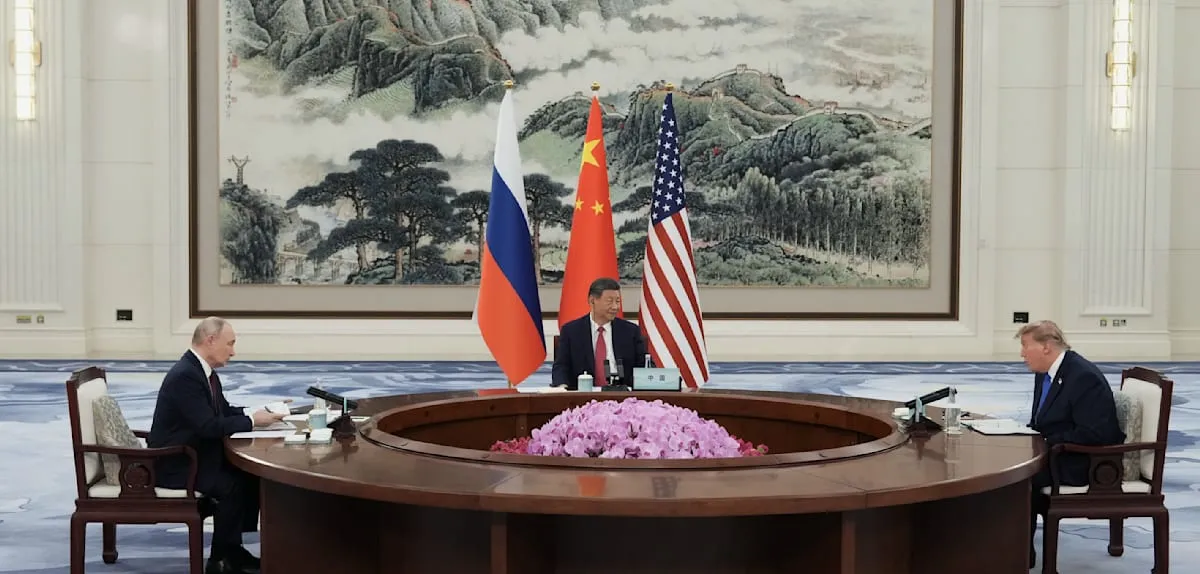
MOSCOW – Russian state media is celebrating a trilateral summit between President Vladimir Putin, United States President Donald Trump, and Chinese President Xi Jinping as the foundation of a new world order. This high-level meeting of global power leaders, held recently, explicitly positions Russia as a third superpower on par with Washington and Beijing.
The narrative widely broadcast by Kremlin news channels vividly portrays the summit as a pivotal moment that will reshape the global geopolitical landscape. Moscow asserts that the era of unilateral dominance has ended, replaced by multipolarity marked by collaboration between these three giants.
Amidst this domestic euphoria, Deputy Chairman of the Russian Security Council, Dmitry Medvedev, issued a pointed statement challenging the European continent. 'Hmm, where is Europe?' he queried, as quoted by Russian media, implicitly questioning Europe's relevance and strategic role in the shifting global power configuration.
Medvedev's question is not merely rhetorical. It reflects Moscow's view that Europe is now reduced to a passive spectator, an entity whose role in determining the direction of international policy is increasingly marginalized.
This triple summit, bringing together heads of state from three of the most influential geopolitical entities, is strategically positioned to challenge the post-Cold War Western hegemony led by the United States. For Russia, the presence of Trump and Xi at this forum validates its claim as a key player on the world stage.
Foreign policy observers note that this summit sends a strong signal about shifting global alliances and priorities. Russia seeks to present itself as a bridge between the world's two largest economic and military powers, as well as a balance of power in the Eurasian region.
Although concrete details of the summit's outcomes were not explicitly detailed by the source, the primary focus is political symbolism and perception shaping. It is a declaration of intent to forge a new global security and economic architecture where Moscow's voice carries significant weight.
Russian media narratives consistently highlight how unity among Washington, Moscow, and Beijing can address global challenges. They imply that issues such as regional stability, cyber security, and international economics will be governed through the consensus of these powers.
Meanwhile, in European capitals, Medvedev's statement and this summit are likely to trigger deep concern. Debates about 'European strategic autonomy' will probably intensify, given the clear indications of attempts to sideline their influence.
Some analyses predict that this incident could prompt European nations to consolidate their ranks, seeking collective strategies to reassert their position. However, internal fragmentation and dependence on the United States remain serious challenges.
Certainly, Europe is not a homogeneous actor. Various European Union member states hold different views and interests regarding relations with Russia, China, and the United States. This makes a coordinated response more complex.
The meeting also draws comparisons to the Cold War period, where the world was divided into power blocs. However, the current multipolar model is more fluid, with alliances capable of shifting depending on issues and national interests.
This summit, without a doubt, will be an important case study for diplomats and geopolitical analysts worldwide. Its long-term implications for multilateral institutions and international norms still need careful observation. It also poses a challenge for Japan's diplomacy seeking to strengthen global influence through diplomatic approaches.
Editorial Insight:
Russia's celebration of this trilateral summit is more than mere diplomacy; it is a blunt geopolitical statement. By raising questions about Europe's position, Moscow cleverly capitalizes on shifting global power dynamics to solidify its status. The biggest challenge for Europe now is to redefine its identity and role within an increasingly competitive order, or risk becoming a peripheral power that can only watch. This indicates a threat to Europe of losing golden opportunities in various sectors.