 Chandra Wijayanto
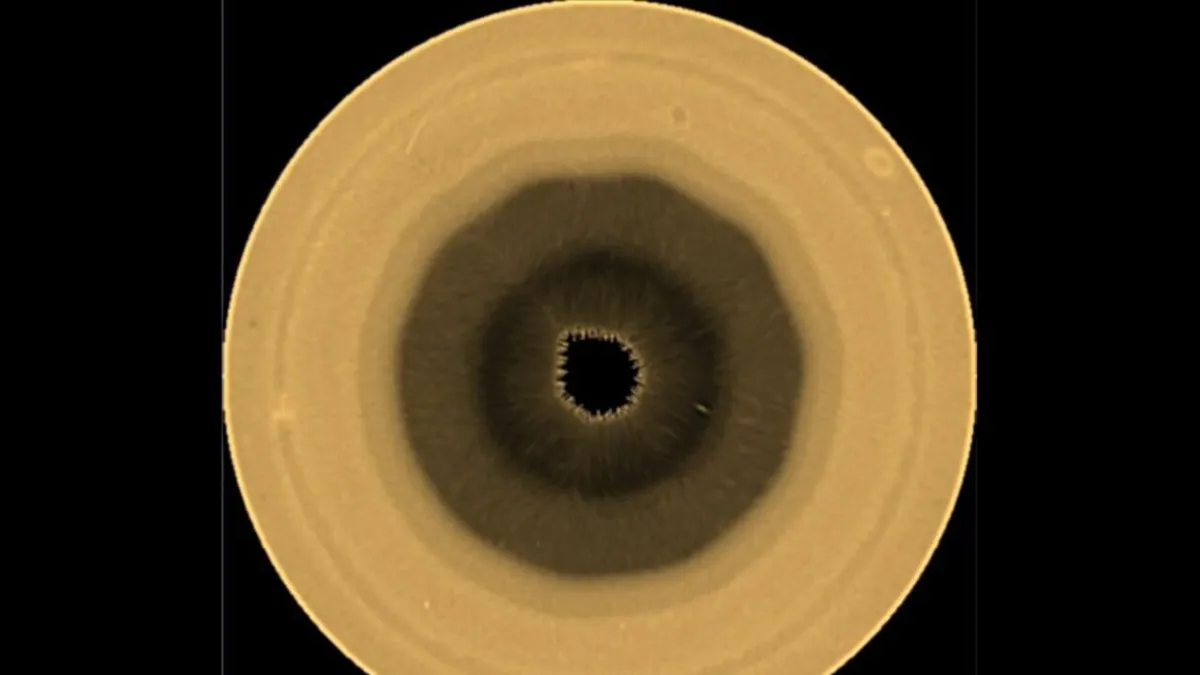
OUTER SPACE – An unusual geometric formation, a colossal ten-sided decagon, has reportedly appeared in the south polar region of Planet Saturn. This startling discovery, occurring in 2026, immediately captured the attention of the global astronomy community due to its resemblance to the long-known hexagonal formation at the ringed planet's north pole. Scientists strongly suspect extreme atmospheric phenomena play a significant role in the creation of this cosmic anomaly.
This newly revealed phenomenon indicates that Saturn's atmospheric dynamics are far more complex and varied than previously estimated. Initial observations suggest the decagon is a result of strong, organized wind currents in Saturn's upper southern atmosphere. The structure is strikingly symmetrical, spanning thousands of kilometers across the planet's pole.
Professor Galih Prasetyo, an astrophysicist from Gadjah Mada University, explained, 'The emergence of a decagon at Saturn's south pole is a strong indicator that there are dynamic mechanisms we do not yet fully comprehend regarding the weather and climate of this gas giant planet.' He added that this finding opens a new chapter in extraterrestrial meteorology studies.
Direct comparison with Saturn's famous northern hexagon has become a hot topic. The northern polar hexagon has been observed for decades and is believed to be formed by Rossby waves, large-scale planetary waves that also play a role in Earth's weather patterns. However, the decagon shape in the south offers a different geometrical complexity.
Researchers are now working diligently to identify whether the formation mechanisms of both phenomena are similar or have unique triggers. Data from space probes, both active and defunct, are being re-analyzed to seek additional clues regarding the decagon's origin.
In-depth study of this giant decagon is expected to provide a better understanding of how the atmospheres of giant planets operate, especially in creating such highly organized, long-lasting structures. The implications of this discovery extend to climate modeling of other planets and even Earth's atmospheric dynamics.
'We are witnessing tangible evidence of the evolution and adaptation of extreme weather patterns in extraterrestrial environments,' stated Dr. Citra Dewi, an atmospheric physics expert from the Bandung Institute of Technology. 'This decagon is not merely a visual oddity; it is a window into the fundamental physical principles that shape our solar system.'
This discovery also fuels speculation about differential rotation periods and the interaction between different atmospheric layers on Saturn. Polar jet streams might create stable conditions for the formation of such regular polygons.
Space observatories worldwide, including the James Webb Space Telescope and various ground-based facilities, are now focusing on Saturn's south pole. Scientists hope to gather spectral data and high-resolution imagery to map the atmospheric composition in the decagon area and understand the energy driving it.
A primary challenge is comprehending how the decagon structure can maintain its precise shape over a considerable period, given the dynamic and turbulent nature of atmospheres. This requires sophisticated computer modeling and high-level fluid physics simulations.
Editorial Insight:
The appearance of a decagon at Saturn's south pole is a fascinating demonstration of the universe's geophysical processes' power and complexity. This discovery not only enriches our understanding of Saturn itself but also challenges existing planetary atmospheric models. Further research holds the potential to unveil universal principles governing large-scale pattern formation on gas giants, providing fundamental insights for astrophysics and planetary science.