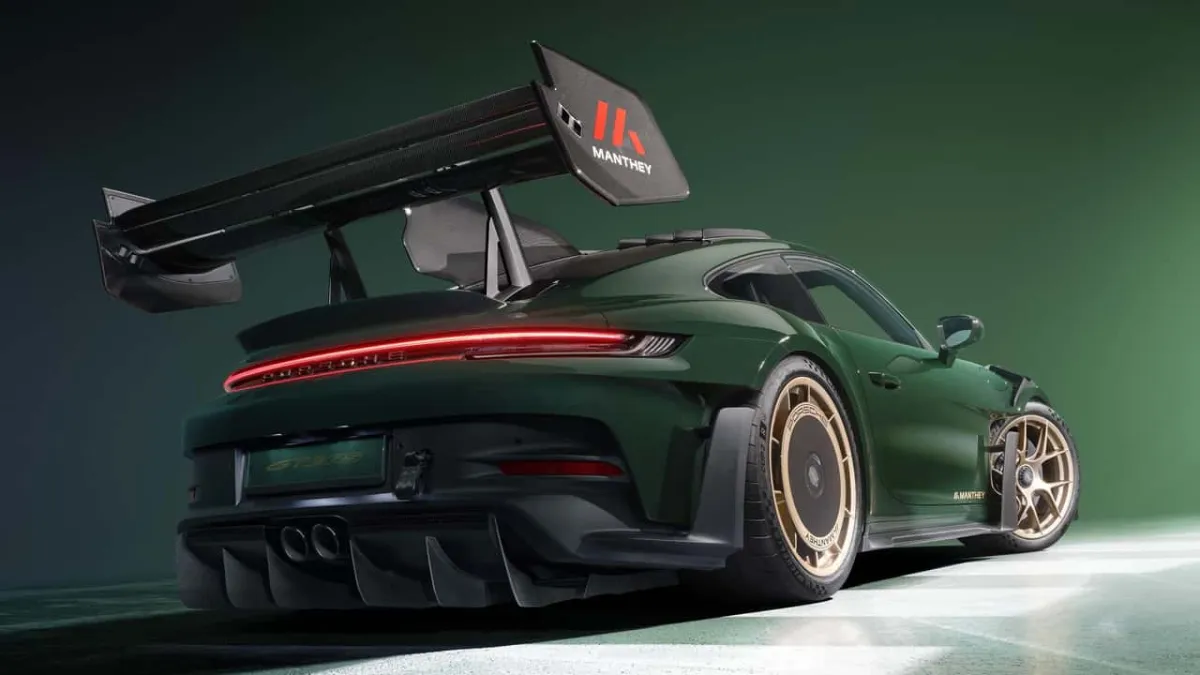
STUTTGART – Porsche, the world-renowned sports car manufacturer, recently stirred the automotive industry with the announcement of their radical innovation: the integration of movable adaptive fins on the front and rear of their vehicles. This cutting-edge technology is designed to significantly enhance lateral force when the car maneuvers on the track, promising much faster and more precise cornering performance. Its development has become a major highlight in early 2026, sparking debate about the future of sports car aerodynamics.
This active aerodynamic system involves small fins strategically mounted on the front trunk lid and the rear glass of the vehicle. As the car enters a corner, these fins will automatically adjust their angle and position, generating lateral downforce that helps the car grip the asphalt more firmly. This concept is similar to aircraft wings adjusting for flight maneuvers, but applied to ground vehicle dynamics.
The primary goal of this innovation is to optimize the car's ability to corner at high speeds. By increasing lateral force, vehicles are expected to maintain optimal speed through sharp bends, reduce lap times on the circuit, and provide a more dynamic driving experience. This represents an evolutionary step in Porsche's continuous effort to remain at the forefront of performance technology.
This is more than just a larger rear wing, stated Dr. Klaus Richter, Head of Aerodynamics at Porsche, during a virtual press conference held last week. We are talking about a smart adaptive system that interacts in real-time with the car's dynamics, providing a crucial advantage at every millimeter of the track. We are pushing the boundaries of physics.
While promising extraordinary performance, this adaptive fin concept also raises several questions and potential challenges. Engineers must ensure that the system is not only effective but also safe and reliable under various driving conditions. Its integration must be seamless with Porsche's iconic aesthetic design.
Some parties have voiced concerns regarding visibility, especially if the rear fins obstruct the driver's view during active maneuvering. Additionally, the potential impact on car stability when facing strong crosswinds has become a hot topic among automotive experts. Porsche asserts that these aspects have been a primary focus during their intensive testing phase.
The idea of active aerodynamics on vehicles is not new, but the implementation of movable adaptive fins on the body is a breakthrough. Previously, many manufacturers focused on active rear wings or adjustable suspension heights. Porsche is adopting a more holistic and decentralized approach to harnessing airflow.
This announcement is expected to trigger a wave of similar innovations from competitors. The luxury sports car market is always a fierce battlefield, and a technological advantage like this can be a significant differentiator. Consumers will ultimately benefit from this aggressive development in the form of faster and safer vehicles.
Prototypes featuring this technology have undergone rigorous testing on various secret circuits. Porsche has not released a definitive timeline for when this technology will appear on mass-produced models, but strong indications suggest that their high-performance vehicles in the coming years will be equipped with this revolutionary feature.
The automotive world now eagerly awaits how Porsche's adaptive fin innovation will transform the paradigm of vehicle performance and design. High hopes are placed on this breakthrough not only to redefine speed but also standards of safety and driving experience.
Editorial Insight: Porsche's adaptive fin innovation marks a significant shift in the approach to aerodynamics. Instead of relying solely on static shapes, the use of movable elements on the body demonstrates the manufacturer's commitment to adaptive dynamic performance. The primary challenge lies in seamless integration without sacrificing aesthetics and daily safety, particularly concerning visibility and stability off the track. If successful, this technology has the potential to become a new industry standard, similar to how dual-clutch transmissions transformed sports car performance.