 Dorry Archiles
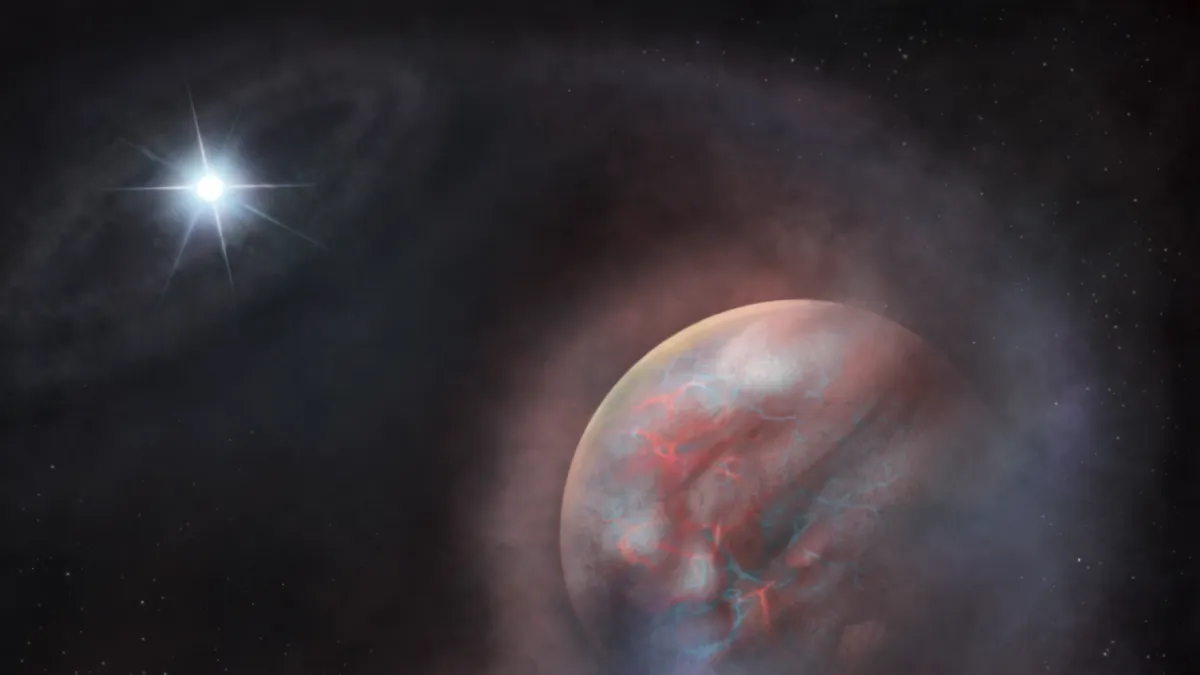
ROME – The global scientific community has been astounded by the spectacular discovery of a phoenix planet, a cosmic object believed to have risen from the ashes of its parent star's destruction. This finding, announced by an international team of astronomers in early 2026, has ignited intense discussions regarding the ultimate fate of our Solar System and Earth's potential future. This revolutionary observation not only enriches our understanding of planetary formation but also opens a new window for contemplating life scenarios post-stellar death.
This unique planet was identified orbiting the remnants of a star that had evolved into a white dwarf, a final phase in the life cycle of stars like our Sun. Contrary to conventional views that planets would perish with their star's death, the existence of this phoenix planet challenges existing models of planetary formation and evolution. Scientists believe that material from the dead star may have re-coalesced to form a new planetary entity.
Researchers utilized next-generation telescopes to observe the star system located hundreds of light-years from Earth. Spectral analysis and photometric data revealed an unusual composition and mass consistent with a planet. Experts hypothesize that this planet might have either reformed from the debris of the star after its red giant phase, or even survived that phase and subsequently undergone dramatic reorganization.
This phenomenal discovery holds immense implications for our understanding of cosmic evolution. Until now, astronomers hypothesized that when a star exhausts its nuclear fuel, it expands into a red giant, engulfing its closest planets, before eventually shrinking into a white dwarf. The presence of a phoenix planet demonstrates the possibility of a more complex and unexpected evolutionary path.
This discovery truly changes how we perceive stellar death and planetary rebirth, stated Professor Dr. Surya Adi Nugroho, a leading astrophysicist from Gadjah Mada University, during a recent virtual press conference. It is not merely about finding a new planet, but about understanding the resilience of cosmic matter and the eternal cycle of creation and destruction in the universe.
The most pressing implication of this discovery pertains to the future of our own Solar System. Billions of years from now, the Sun is expected to become a red giant, expanding and potentially engulfing Mercury, Venus, and even Earth. Subsequently, the Sun will shrink into a white dwarf, leaving behind a cold, dense remnant.
However, the phoenix planet now offers a glimmer of hope or at least an alternative scenario. Could Earth, or other planets in our Solar System, endure in some form after the Sun's demise? Or, will the remaining material someday reform new planets around the Sun's white dwarf?
Scientists are now focused on further studies of this planet's composition and orbital dynamics. They hope to unravel the mystery of how it could have reformed or survived the catastrophic event that destroyed its parent star. New simulation models are being developed to test various hypotheses.
This discovery also pushes the boundaries of exoplanet exploration. If planets can be reborn after their star's death, then the number of potentially habitable planets in our galaxy could be far greater than previously estimated. This opens new avenues in the search for extraterrestrial life, even in star systems once considered defunct.
The phenomenon of the phoenix planet offers a breathtaking perspective on the universe's life cycle, an eternal dance between destruction and creation. It raises profound philosophical and scientific questions about the resilience of matter and the potential for cosmic continuity.
Editorial Insight:
The discovery of this phoenix planet is not only a historical milestone in astrophysics but also sparks profound public discussions about the universe's destiny. It serves as a reminder that our understanding of the cosmos remains vastly limited, with ample room for paradigm-shifting surprises. Moving forward, this research will likely catalyze greater investment in telescope technology and space missions, aiming to uncover more mysteries hidden behind stellar death and planetary rebirth. Its long-term implications may redefine our search for extraterrestrial life.