 Gabriella
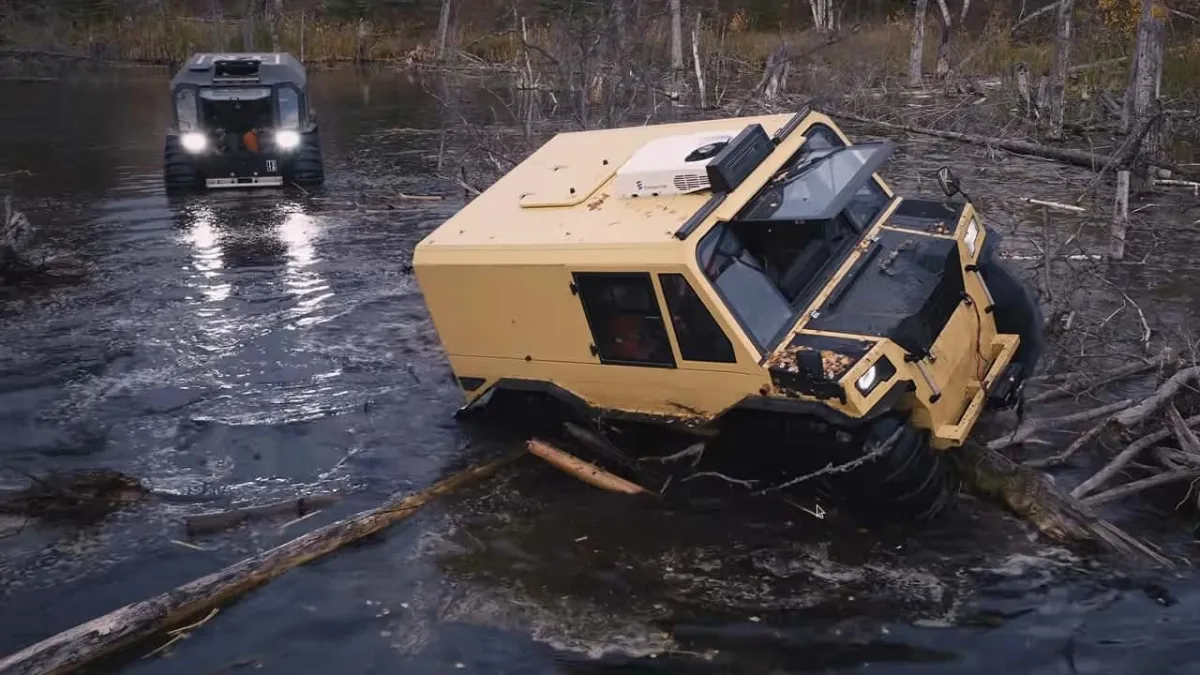
REGINA – The giant-tired amphibious Sherp vehicle once again captivated the online world after two YouTubers, Shaun Walford and Dave, pushed its limits to the extreme in the wild terrains of Saskatchewan, Canada. This challenging expedition involved conquering Whiteswan Lake and an extremely overgrown swamp loop, proving Sherp's moniker as a nearly unstoppable off-road king.
The experiment, captured in their video, demonstrated how the Sherp, with its unique design featuring massive tires and amphibious capabilities, could navigate even the most formidable geographical conditions. From vast lake surfaces to thick swamp mud, the vehicle showcased astonishing performance, seemingly defying the laws of physics.
Shaun Walford, known for his adventures, expressed his satisfaction with the trial. We wanted to see how far the Sherp could go. Whiteswan Lake and these swamps were the perfect place for it. This vehicle never ceases to impress us, he stated, reinforcing Sherp's reputation as a vehicle designed for extreme terrain.
This test was not merely a spectacle but also a validation of the engineering innovation embedded in the Sherp. The vehicle is equipped with an automatic tire inflation system that allows drivers to adjust tire pressure according to terrain conditions, providing optimal traction on various surfaces—from slippery rocks to quicksand-like mud.
Sherp's compact yet rugged design also enables maneuvers in narrow and overgrown areas, as observed during its traverse of the swamp loop. This capability adds significant value, especially for those requiring a versatile vehicle for exploration or work in remote locations.
Dave, Walford's counterpart, added that the experience of driving the Sherp in such an environment was unparalleled. It feels like driving a boat on land, or a tank in water. The boundary between land and water blurs. It's truly revolutionary for the off-road world, he enthusiastically remarked.
This incident solidifies Canada's position as a hub for wilderness exploration, while also highlighting the presence of an off-road enthusiast community continually seeking new innovations and challenges. The use of vehicles like the Sherp opens new possibilities in research, rescue, or simply extreme adventure.
The Sherp phenomenon has also sparked discussions among automotive enthusiasts and environmentalists about the balance between extreme exploration and its impact on ecosystems. Although the Sherp is designed for minimal impact, there is always concern about the footprint left on natural habitats.
The now-viral video not only entertained millions of viewers but also served as an intriguing case study in automotive engineering. It demonstrates that with the right technology, seemingly impossible boundaries can be overcome, pushing the limits of all-terrain vehicle capabilities.
The Sherp's success in conquering Whiteswan Lake and the Saskatchewan swamps could become a benchmark for the development of similar vehicles in the future. Automotive manufacturers continue to innovate, as seen in other extreme modification projects. For more information on high-performance vehicles, you can read our article on Corvette Z06 2027: Twin-Turbo Mod Outperforms Chevy Factory! or see how Lexus TX1: Luxury Tacoma-Based Pickup Ready to Shake Up the Automotive Market in 2026? is preparing to enter the market.
Editorial Insight: The Sherp demonstration by Walford and Dave is more than just an entertainment stunt; it is a showcase of remarkable engineering prowess. Amidst the need for mobility in challenging terrains for various sectors, from logistics to disaster mitigation, vehicles like the Sherp offer vital solutions. Its potential for further development or adaptation for specific applications is immense, marking a significant evolution in all-terrain vehicle design.