 Stefani Rindus
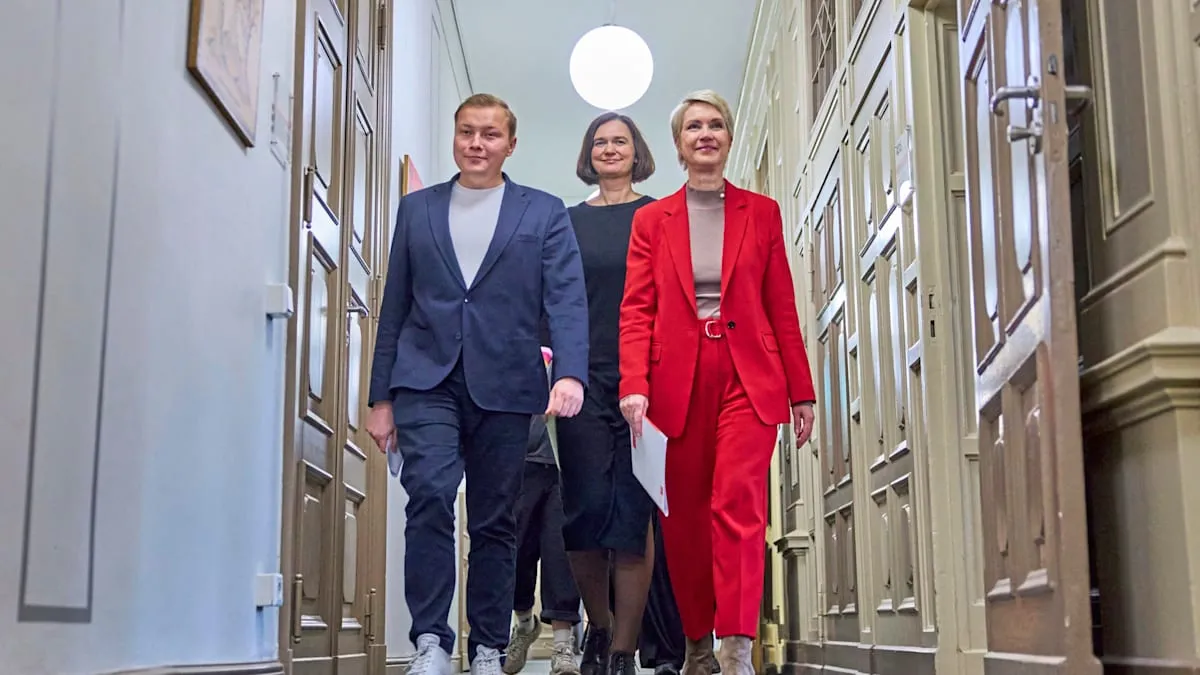
GUEESTROW – The Social Democratic Party (SPD) has officially approved a coalition agreement with the Left Party (Die Linke) and the Green Party (Bundnis 90/Die Gruenen) during a special party conference held in Gueestrow. This decision paves the way for the formation of the first Red-Red-Green government in the state of Mecklenburg-Vorpommern, Germany, marking a significant shift in the regional political landscape in 2026.
The approval, reached on Sunday following intensive negotiations between the three parties, confirms the establishment of a progressive alliance aimed at addressing the social, economic, and environmental challenges facing the Baltic coastal region. SPD delegates provided strong support, following similar endorsements from the Left Party and the Green Party earlier.
This Red-Red-Green coalition, a formation combining social-democratic, democratic socialist, and environmental forces, is considered a historic milestone for Mecklenburg-Vorpommern. The region has traditionally been known for its political stability, often dominated by more conservative or two-party majorities.
The formation of this alliance reflects Germany's increasingly complex political dynamics, where no single party can form a government independently amidst challenges that have seen Germany grappling with a global crisis. The need for consensus and compromise is at the core of this new cabinet's formation, which is expected to focus on crucial issues such as energy transition, sustainable economic development, and strengthening public services.
A German political observer from the University of Berlin, Professor Klaus Richter, highlighted the significance of this coalition. The Red-Red-Green alliance in Mecklenburg-Vorpommern indicates a broader trend in German politics. Left and center-left parties are increasingly finding common ground to form strong governing blocs, especially in confronting climate challenges and social inequality, Richter stated.
The new government is expected to formulate an ambitious work program promptly. Key focuses include investments in digital infrastructure, enhancing educational quality, and reforming local healthcare systems. They will also face the formidable task of balancing economic growth with environmental protection in a region rich in natural beauty.
This decision also has the potential to send a signal to the national political stage. The success or failure of this coalition could serve as a barometer for similar government formations in other German states or even at the federal level in the future, particularly in the context of debates surrounding the future of energy and social policies.
Opposition parties in Mecklenburg-Vorpommern have declared their readiness to closely monitor every step taken by this new coalition. They emphasized their commitment to being a constructive yet critical counterbalance, ensuring that every policy enacted genuinely serves the interests of the people.
The agreed-upon coalition agreement reportedly includes a detailed series of commitments, ranging from carbon emission reduction targets to programs for enhancing youth employment. The alignment of vision among these three parties is crucial in realizing their development agenda.
This historic moment is not merely about power-sharing but also about efforts to respond to the aspirations of the citizens of Mecklenburg-Vorpommern who desire a responsive and visionary government. While the challenges ahead are significant, the spirit of collaboration serves as the primary asset for this Red-Red-Green coalition.
Editorial Insight: The formation of the Red-Red-Green coalition in Mecklenburg-Vorpommern marks a new chapter in Germany's political experimentation. It demonstrates the flexibility and adaptability of the parliamentary system in finding solutions amid political fragmentation. The success of this alliance will largely depend on the ability of its leaders to manage ideological differences for common goals, as well as their willingness to confront complex economic and social realities. This is a concrete example of how center-left parties are striving to unite forces to shape a progressive agenda within an evolving political landscape.