 Chandra Wijayanto
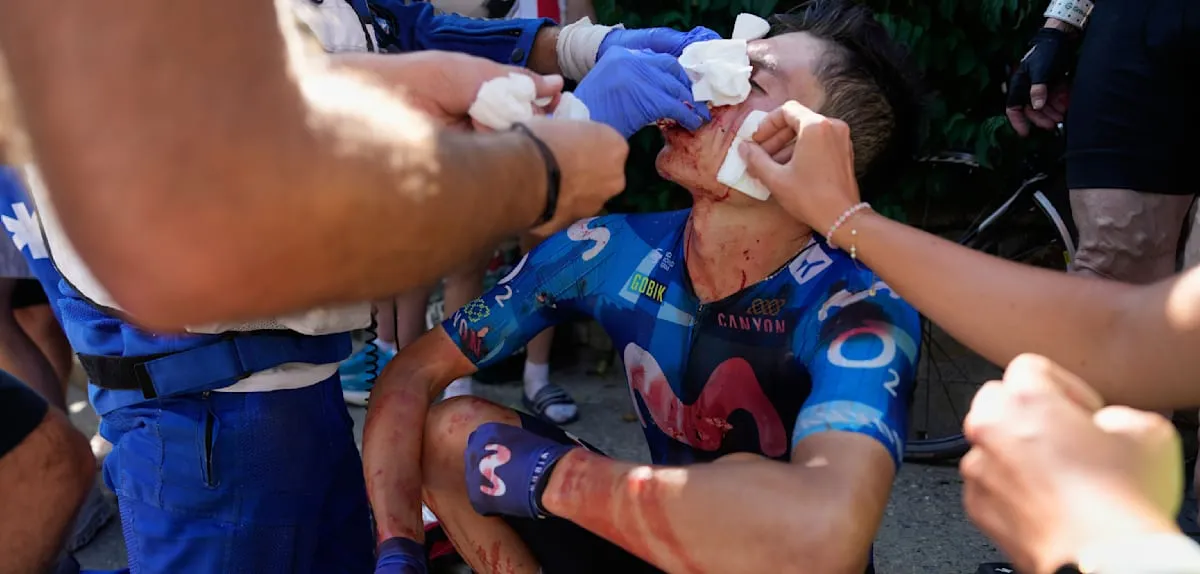
Alpe d'Huez — A shocking incident rocked a crucial stage of the 2026 Tour de France on the legendary Alpe d'Huez climb, when professional cyclist Einer Rubio of the Movistar team was involved in a serious accident. He crashed into a team support vehicle after it performed an emergency brake, reportedly triggered by a fan's presence on the cycling route, leaving Rubio lying bloody on the road.
This unfortunate event occurred at a critical moment in the race, as cyclists were exerting all their energy to conquer the iconic elevation. High speed is a given in the Tour de France, and any minor incident can be fatal, as happened to Rubio.
According to eyewitnesses and initial reports, the team's support vehicle came to a sudden complete stop. The trigger, it is believed, was a fan who was too close to the race path, creating an unavoidable dangerous situation for both the vehicle and the cyclist behind it.
Rubio, who was behind the support vehicle, did not have enough time to react. His body hit the back of the vehicle hard, causing him to be thrown and fall onto the asphalt in a harrowing condition, bleeding from his injuries.
Medical teams immediately acted quickly. They rushed to provide first aid to Rubio, who was still lying on the ground. The exact nature of his injuries is still awaiting further examination at the nearest hospital, but the severity of the incident was evident from the pool of blood at the scene.
The incident immediately caused deep concern within the global cycling community. Questions about rider safety, especially concerning interactions with spectators, once again came to the forefront.
Alpe d'Huez, with its famous 21 hairpin bends, has always been a magnet for fans. However, excessive enthusiasm often creates risks. This incident serves as a bitter reminder of the boundary between support and danger.
The organizers of the Tour de France and the Union Cycliste Internationale (UCI) are highly likely to launch a thorough investigation. The primary focus of the inquiry will be on safety protocols and how to prevent similar incidents from recurring in the future.
A series of similar accidents have marked the history of cycling, often involving spectators who are too close to the race route. This underscores the urgency of re-evaluating crowd control policies during crucial stages.
Team Movistar, through a brief statement, expressed deep concern for Einer Rubio's condition. They hope their rider recovers quickly and can return to competition, while awaiting further updates from the medical team.
This accident also sparked a fierce debate about shared responsibility. Not only organizers and teams, but also fans have a vital role in ensuring the smooth running and safety of every race stage.
The psychological impact on other riders also needs to be considered. Seeing a colleague lying bloody on the track can cause trauma and affect their concentration for the remainder of the race.
This tragic event on the iconic climb will be recorded as one of the most dramatic moments in the 2026 Tour de France, highlighting the vulnerability of athletes in this adrenaline-filled sport.
The need for stronger barriers, wider safe zones, and more intensive public education seems set to become a priority agenda after this incident, to protect the integrity of the race and the lives of the riders.
This incident reiterates that although cycling is a spectacular show, safety remains the top priority that cannot be compromised.