 Demian Sahputra
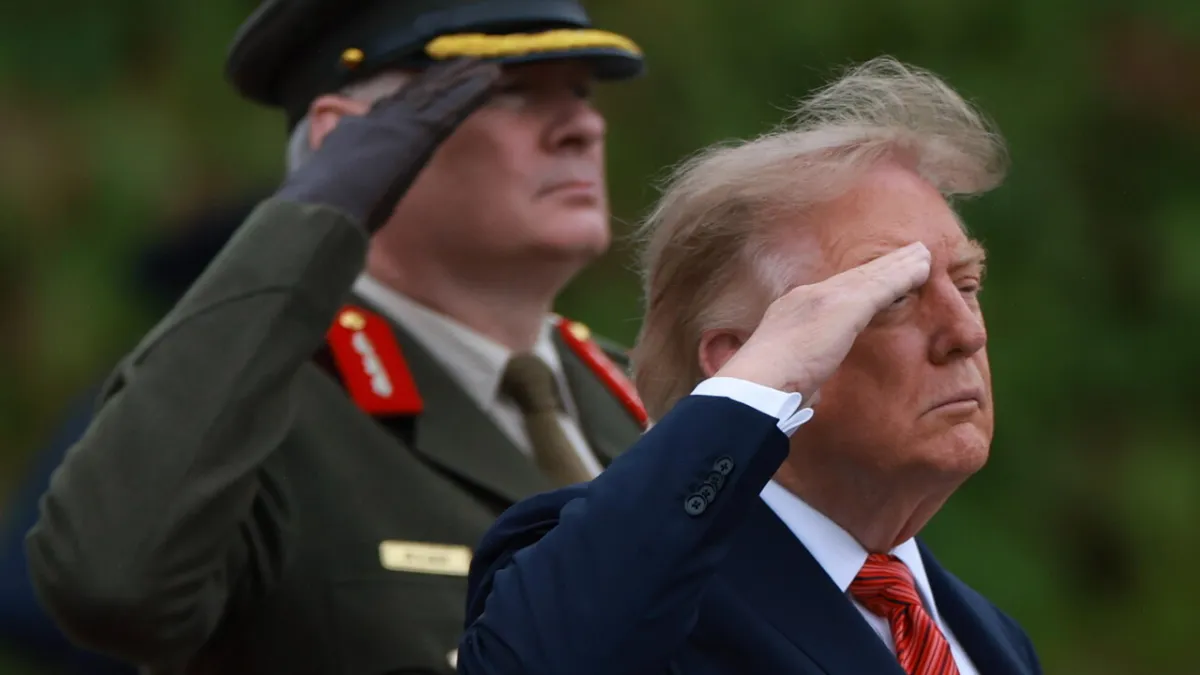
DUBLIN – U.S. President Donald Trump has once again stirred a wave of diplomatic debate during his two-day visit to the island of Ireland, emphatically stating that A united Ireland would be fantastic. This declaration immediately reignited an old controversy surrounding the geopolitical status of the region, an issue always fraught with historical baggage and high sensitivity.
The controversial comments from the leader of the superpower came as he engaged in a series of private engagements and meetings, including playing golf. However, the reception to the idea of unification was not uniform. Andy Burnham, a relevant public figure in political discourse, quickly responded by saying there was no public support for such a proposal at present.
A cautious stance was also expressed by the spokesperson for the British Prime Minister, who reiterated the governments position on Northern Ireland. This statement implies that London remains committed to the principles agreed upon in the peace treaty and respects the wishes of all communities in Northern Ireland.
The issue of Irish unification is not merely an ordinary political discourse; it lies at the heart of national identity narratives, a history of conflict, and a fragile peace agreement. A statement from a head of state like Trump carries significant political weight and could potentially disrupt the delicate balance painstakingly built over years of arduous negotiations.
President Trumps two-day visit to Ireland featured a blend of informal diplomacy and personal recreation. In addition to meetings with local officials, he also took time to play golf, a hobby he frequently enjoys. Nevertheless, these relaxed moments were punctuated by statements carrying serious geopolitical implications.
Understanding the historical context, Ireland has been divided into the Republic of Ireland (a sovereign state) and Northern Ireland (part of the United Kingdom) since 1921. The Good Friday Agreement in 1998, which ended three decades of bloody conflict, stipulated that the status of Northern Ireland could change if a majority of its inhabitants wished for unification through a referendum.
However, the debate surrounding this issue resurfaced after Brexit, raising concerns about physical and economic borders between the two Irish entities. President Trumps statement further complicates the situation, seeming to reopen a Pandoras box that had been painstakingly closed.
Many view Trumps intervention as an attempt to garner attention or even test political responses in an already vulnerable region. Public sentiment in Northern Ireland itself is sharply divided between those who are pro-British (Unionists) and those who are pro-united Ireland (Nationalists).
Andy Burnhams rejection of the idea, citing a lack of public support, underscores the political reality that any unification proposal must stem from the collective will of the people, not from external pressure. Domestic consensus is the paramount key to any fundamental constitutional change.
The role of the British Prime Ministers spokesperson in reiterating the governments position is also vital. This demonstrates Londons commitment to maintaining stability and respecting international agreements governing Northern Irelands status, as well as preserving good relations with the Republic of Ireland.
Donald Trumps views, as the U.S. President, undeniably exert significant influence in global diplomatic circles. However, international political analysts question whether this statement is part of a planned diplomatic strategy or merely a reflection of his often-provocative personal opinions.
The issue of Irish unification is highly complex, involving deep economic, social, cultural, and security considerations. Any move towards it requires meticulous planning and broad support from all stakeholders in Dublin, Belfast, and London.
In a broader context, Trumps statement can also be seen as one of the jolts to European stability, as highlighted in the related article Trump Shakes European Stability: Fully Supports Irish Unification!. Such interventions often have ripple effects that extend beyond immediate geographical boundaries.
Moving forward, it will be interesting to observe how the Irish and British governments will respond to this rhetorical pressure. Regional stability remains a priority, and any actions with the potential to incite tension must be carefully anticipated.
Editorial Insight: President Trumps statement regarding Irish unification, though delivered casually during a visit, has the potential to reignite a sensitive debate. Without strong public majority support and political consensus from both sides of the island of Ireland, this idea of unification remains far from reality. Such statements from a global leader can disrupt diplomatic equilibrium and demand cautious responses from involved parties to maintain long-fought regional stability.