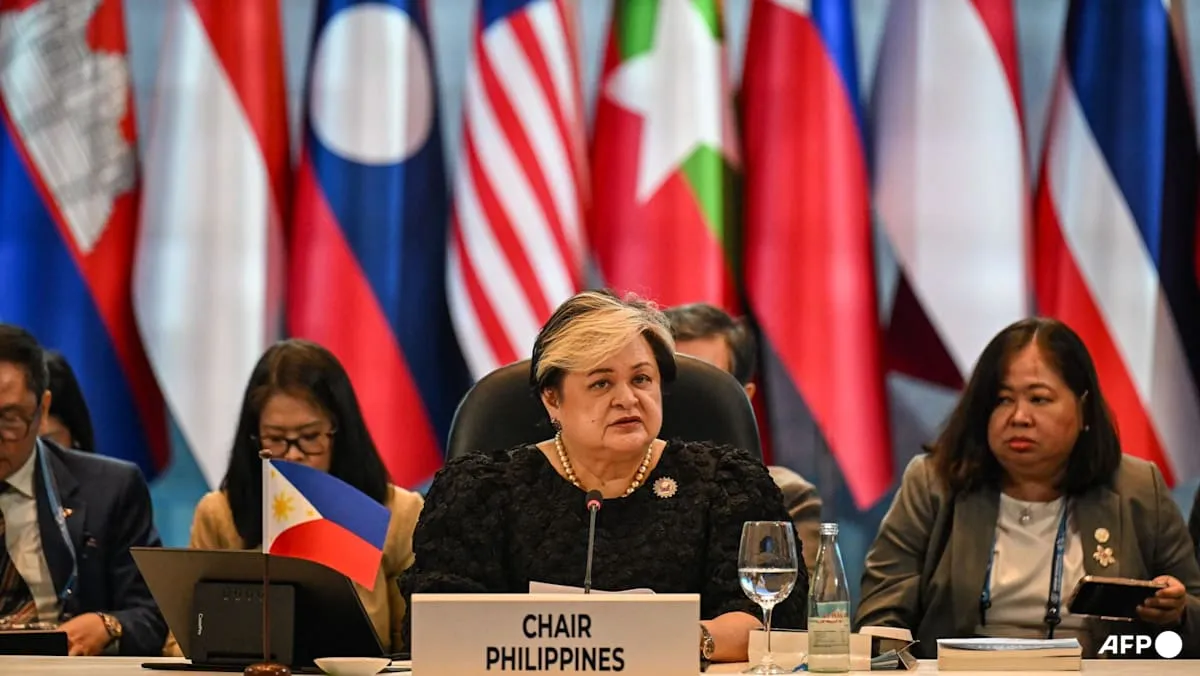
MANILA – ASEAN has affirmed its unwavering stance, stating it will not relax its approach towards Myanmar. Philippine Foreign Affairs Secretary and ASEAN Special Envoy, Maria Theresa Lazaro, declared in 2026 that the regional bloc remains consistent in implementing its Five-Point Consensus to address the political and humanitarian crisis plaguing the nation. This statement simultaneously dispels speculations regarding a potential shift in ASEAN's strategy.
Lazaro underscored the critical importance of adhering to the Five-Point Consensus (5PC), which ASEAN leaders agreed upon in April 2021 in Jakarta. This document calls for:
- An immediate cessation of violence.
- Constructive dialogue among all relevant parties.
- The appointment of an ASEAN special envoy to facilitate mediation.
- The provision of humanitarian assistance.
- The special envoy's visit to Myanmar to meet with all stakeholders.
However, the implementation of the 5PC has encountered severe challenges. The military junta that has governed Myanmar since the 2021 coup has repeatedly failed to fulfill its promises and refused to cooperate fully with ASEAN's special envoy. This situation has exacerbated the crisis, fueling ongoing violence and socioeconomic turmoil.
The humanitarian situation in Myanmar continues to deteriorate. Recent reports document incidents of violence leading to civilian casualties, such as the aerial terror incidents in displacement camps. The world demands justice for the Aerial Terror in Myanmar that claimed many innocent lives, stated a regional political observer.
ASEAN's firm stance against easing its approach reflects the collective frustration of member states over the lack of progress. The Five-Point Consensus remains the only regionally agreed-upon framework, despite questions raised by some parties regarding its effectiveness.
The Philippines, as a founding member of ASEAN, plays an active role in advocating for peaceful resolution and the upholding of democratic principles in Myanmar. Secretary Lazaro's involvement as special envoy highlights Manila's commitment to this issue. The Philippines also continues to strengthen regional ties, as seen in its trade agreement with Canada that smooths Asian economic flows.
Several other ASEAN member states have also voiced similar concerns. Singapore, slated to chair ASEAN in 2027, has demonstrated a strong commitment to regional stability, as expressed by Prime Minister Wong during his visit to Manila. Such solidarity in maintaining this position is crucial for ASEAN's credibility as a regional organization.
Despite the focus on Myanmar, ASEAN continues to advance other initiatives that strengthen regional integration. Recently, the bloc inaugurated a Digital Economy Pact, showcasing ASEAN's ability to collaborate in economic and technological spheres.
International pressure on Myanmar's junta also continues to mount. The UN and various Western nations urge ASEAN to take more decisive action, even though the bloc traditionally upholds the principle of non-interference in member states' internal affairs.
Lazaro's declaration underscores that ASEAN will not overlook this crisis, even if progress is slow. This sends an important message to the Myanmar junta that regional pressure will persist, and that the international community, through ASEAN, continues to monitor the situation closely.
Editorial Insight: ASEAN's resolute stance, articulated by Maria Theresa Lazaro, represents an effort to maintain the bloc's relevance and credibility amidst the protracted Myanmar crisis. The failure to implement the Five-Point Consensus has tested the limits of ASEAN's non-interference principle. Consistency in this approach, without leniency, could form the basis for more innovative strategies or coordinated sanctions in the future, aiming to press the junta towards constructive dialogue and the restoration of democracy. This also signals that ASEAN will not allow the Myanmar issue to undermine regional integrity as a whole.