 Robert Andrison
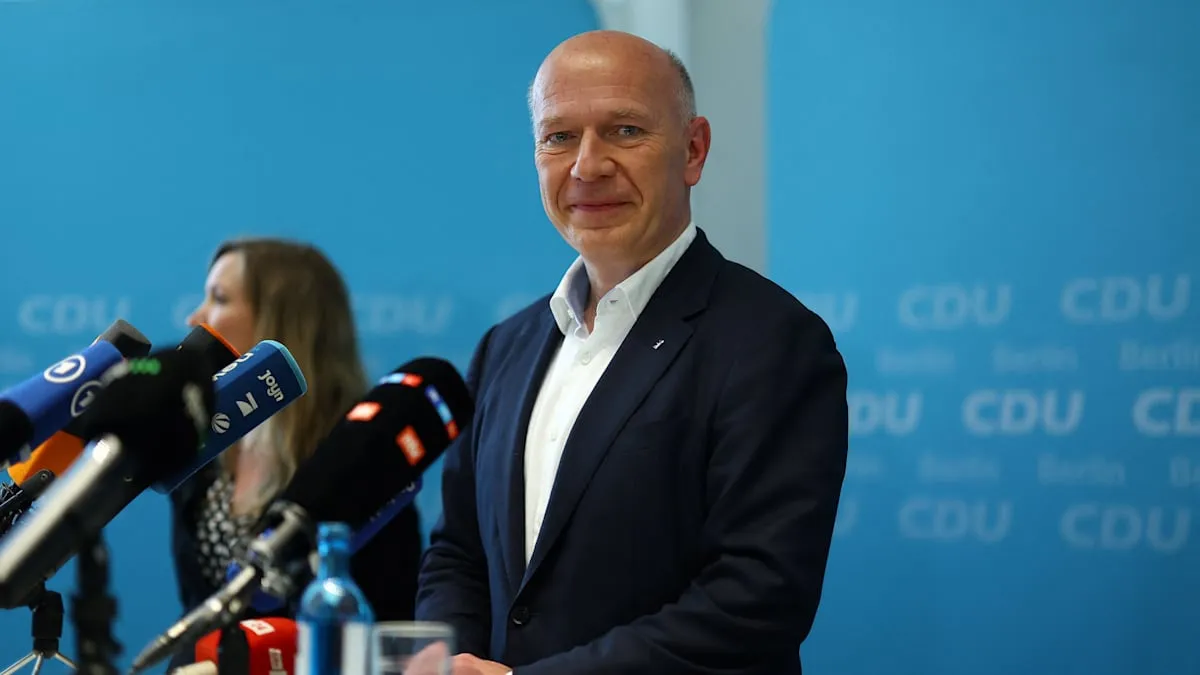
BERLIN — Berlin's Governing Mayor, Kai Wegner of the Christian Democratic Union (CDU), today surprisingly announced his withdrawal from the top candidacy for the Berlin House of Representatives election scheduled for September 2026. This drastic decision follows Wegner's public admission of having made significant "communicative errors," a confession that has shaken the political landscape of the German capital and raised major questions about the stability of the coalition government.
The announcement was made by Wegner in a full statement broadcast by national media. His statement highlighted the burden of responsibility for miscommunications that may have hindered public and internal party trust. He did not specify the nature of these errors, but this withdrawal is seen as a step towards taking full accountability.
Wegner's step down marks a new period of uncertainty for the Berlin CDU, which now must scramble to find a replacement to lead the campaign in a crucial election. The September 2026 election is predicted to be a fierce battle amidst increasing political polarization and socio-economic challenges facing Berlin.
Political observers consider this decision a major blow to the CDU's credibility at the local level. Since taking office as Governing Mayor, Wegner has indeed faced several sensitive issues that sparked public debate, including the handling of the housing crisis and environmental policies.
Wegner's statement, "I made communicative errors," indicates a gap in communication strategy or interaction with stakeholders, both within his party and with the wider public. This could relate to criticisms of the city government's transparency or responsiveness.
One issue that had sparked controversy was related to new curfew regulations in Berlin which had triggered public anger and legal challenges. Although not directly cited as the cause, such cases can erode trust and be seen as political communication failures.
Reactions from the opposition camp quickly emerged. Representatives from the Green Party and Die Linke immediately seized this momentum to criticize the CDU's leadership, highlighting the internal turbulence now plaguing the ruling party. They questioned the CDU's ability to effectively lead Berlin ahead of the important election.
Within the CDU itself, the decision is said to have caused a mix of disappointment and support. Some understand Wegner's move as a chivalrous act to maintain party integrity, while others worry about its negative impact on the CDU's chances of winning the upcoming election. This situation is similar to the dynamics of internal scandals that have also rocked other parties.
The CDU Berlin Regional Executive Board is scheduled to hold an emergency meeting soon to discuss the implications of Wegner's resignation and set a forward strategy, including the selection process for a new candidate. Potential names have begun to circulate among journalists, but there has been no official confirmation.
The people of Berlin now await further clarity regarding the direction of their city's leadership. With the September 2026 election drawing nearer, the political dynamics in the German capital are certainly expected to heat up, with a focus on who will be the CDU's new helmsman and how they will face the complex challenges ahead. Wegner's withdrawal is not merely a change of candidate, but a reflection of the high pressures and expectations placed on political leaders in the modern era.