 Chris Robert
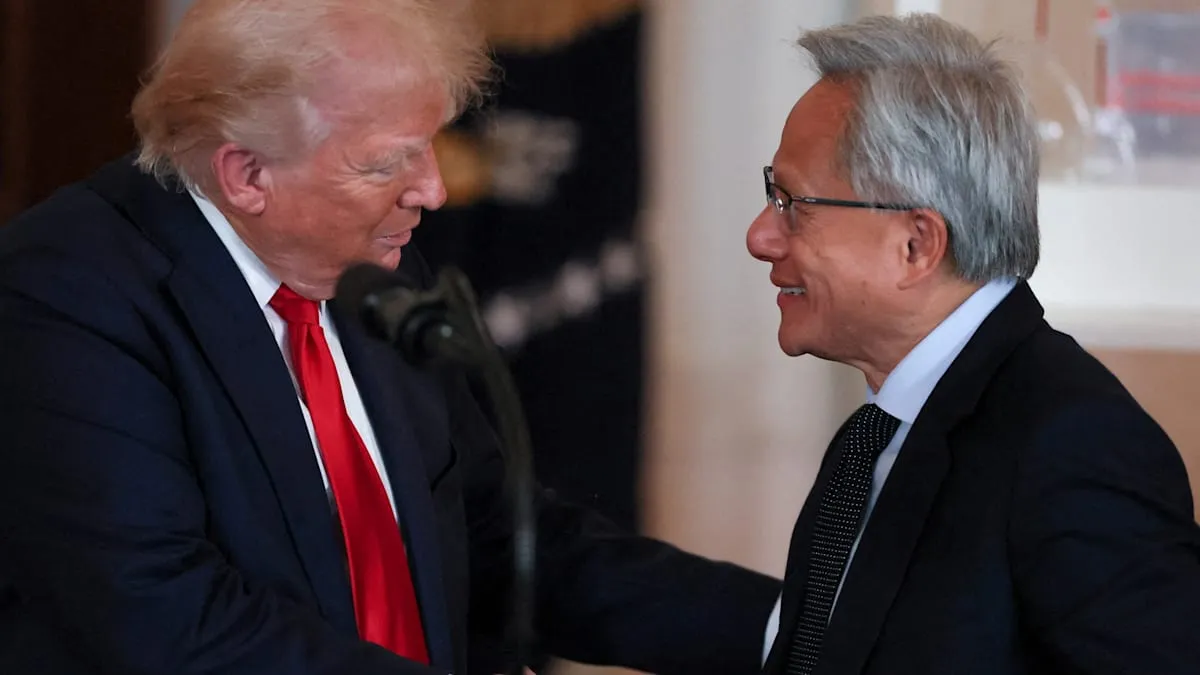
WASHINGTON – Prominent transatlantic expert, Sandra Navidi, recently launched a scathing critique of United States policies and the unchecked pace of artificial intelligence (AI) development. Navidi explicitly described the current approach as 'a band-aid on cancer', a powerful analogy suggesting that fundamental issues remain unaddressed and merely covered up.
Navidi's criticism emerges amidst global tech market turmoil in 2026, with a sharp focus on Jensen Huang's return as Nvidia's CEO. This decision, according to Navidi, raises a series of serious questions, particularly concerning potential insider trading practices that could benefit certain parties.
Furthermore, Navidi also highlighted the substantial profits reportedly accrued by United States President, Donald Trump. This situation further strengthens the view that there is a significant disparity between the difficulties faced by the public and the prosperity enjoyed by a select few elites.
Navidi's analysis underscores a profound failure in how the US government handles economic and technological challenges. According to her, this 'band-aid on cancer' is not just a metaphor; it is a reflection of unsubstantial policies that fail to resolve root problems and merely delay a greater collapse.
The artificial intelligence sector, which should be a locomotive of innovation, is now under critical scrutiny. Navidi argues that the massive growth of AI without adequate regulation creates huge gaps for exploitation and injustice. This exacerbates the 'cancer' that weak policies attempt to cover with a 'band-aid'.
Jensen Huang's return to the helm of Nvidia, one of the AI chip giants, is a crucial point. The company holds a dominant position in the semiconductor market, vital for AI development. The alleged insider trading raised by Navidi indicates concerns about market integrity and potential manipulation behind the scenes.
This issue reminds the public of a long history of financial scandals involving major figures and technology companies. Capital market integrity is at stake when such accusations surface, potentially shaking investor confidence and global economic stability.
- The relationship between government policy, technological development, and personal gain forms a common thread in Navidi's views. Corruption and unethical practices, if proven, would erode the foundation of public trust in government institutions and corporations.
- Criticism of the United States government is not new, but Navidi's description of it as a 'band-aid on cancer' adds a new dimension to the severity of the situation. It suggests that fundamental issues such as economic inequality and a lack of regulation in new sectors like AI are eroding the system from within.
The significant profits earned by Donald Trump amid this criticism also raise questions about conflicts of interest and how positions of power can be used for personal financial gain. Transparency and accountability are key demands from the public and observers.
Nvidia's dominance in the AI chip market has been a major concern, especially after massive acquisitions in related sectors. Allegations of insider trading could worsen negative perceptions of big tech's business practices, which are often accused of monopolizing the market and hindering fair competition.
This criticism should serve as a wake-up call for policymakers in Washington. They must move beyond superficial solutions and dare to confront the real 'cancer', which is the structural problems hindering fair and sustainable progress.
Editorial Insight: Sandra Navidi's statement is more than just ordinary criticism; it is a stark warning against the illusion of progress amidst acute fundamental problems. The 'band-aid on cancer' narrative sharply illustrates systemic failures in responding to contemporary challenges, from AI regulation to the ethics of power. Without bold and transparent policy interventions, the crisis of public trust and global economic stability will be further jeopardized. A thorough investigation into alleged Nvidia insider trading and Donald Trump's profits is crucial to restoring market integrity and public confidence.