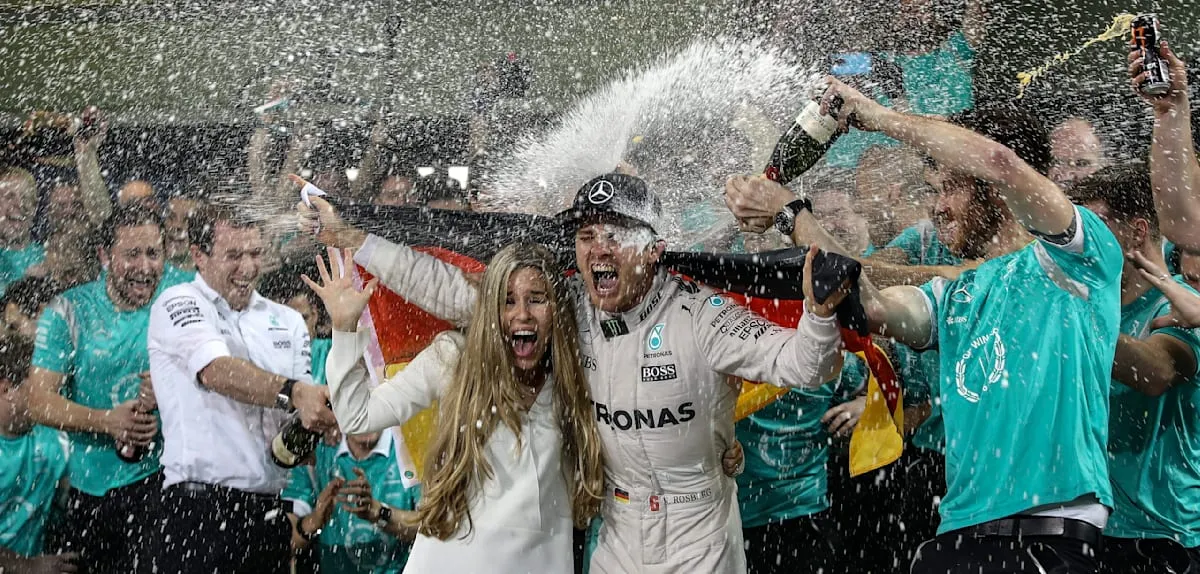
LONDON – Former Formula 1 world champion, Nico Rosberg, has finally revealed the unusual strategic details he employed to defeat rivals, including teammate Lewis Hamilton, in the pursuit of the world title during the 2016 racing season. Exactly a decade after that historic moment, Rosberg disclosed one of his extreme measures: scraping layers of paint from his racing helmet to save 80 grams. This innovative step garnered attention, highlighting the level of dedication a driver extends to achieve peak performance in the most prestigious open-wheel racing event.
Rosberg's admission emerges amidst the tenth-anniversary celebrations of his victory, offering a new perspective on the intensity of competition in Formula 1. At that time, every milligram, every fraction of a second, could determine the difference between triumph and defeat, especially in the internal duel within the Mercedes-AMG Petronas F1 team.
'I scraped the paint off my helmet, that saved 80 grams,' Rosberg stated, illustrating the lengths to which he was willing to go. While 80 grams may seem minuscule, it carries significant implications in the world of Formula 1, where aerodynamics and weight distribution are paramount to performance. Even the slightest weight reduction can affect a car's balance and steering response, which is critically important for drivers.
The 2016 season is remembered as one of the most thrilling in Formula 1 history. The rivalry between Rosberg and Hamilton reached its zenith, with both drivers fiercely competing in every race. The psychological and physical pressures they endured were immense, pushing both drivers to seek every possible advantage.
Rosberg, who had spent years in Hamilton's shadow, demonstrated unwavering resolve to turn the tide. His decision to implement this unconventional helmet modification reflects a champion's unyielding mentality, where every detail is scrutinized to achieve the highest ambition.
'The title fight was insane,' Rosberg recalled, describing how every aspect of his life was focused on one goal: becoming the Formula 1 world champion. He even claimed that he could no longer 'maintain his private life' during the 2016 season, indicating an unimaginable level of sacrifice.
Innovation and marginal gains strategies have always been an integral part of Formula 1. From revolutionary engine development to the tiniest aerodynamic details, racing teams constantly chase advantages. Rosberg's actions serve as a reminder of how a holistic approach to performance, encompassing both technological aspects and a driver's personal dedication, can shape the final outcome.
Mercedes, as the dominant team in the hybrid era, provided Rosberg and Hamilton with competitive vehicles. Ultimately, however, individual skill and clever driver strategies determined who would emerge victorious. Rosberg's story is tangible proof that the courage to think outside the box, even in small matters, can lead to monumental differences.
This phenomenon is not limited to Formula 1. The broader automotive industry continually innovates to achieve better efficiency and performance, similar to how Porsche continues to develop technologies like adaptive fins for car maneuvering. Small yet strategic steps often prove decisive in fierce competition.
After securing the coveted world title, Nico Rosberg surprisingly announced his retirement from Formula 1 just a few days later. This decision further underscored the immense burden he carried throughout the 2016 season and how the pinnacle of his career had truly depleted all his energy.
This revelation highlights the essence of high-level professional sports: it is not just about talent and machinery, but also about an obsession with detail, boundless sacrifice, and the willingness to push beyond conventional limits for victory. Rosberg proved that in a fierce title battle, every gram, every decision, truly matters.
Editorial Insight: Nico Rosberg's story from a decade ago is more than just a light anecdote about weight saving. It is a sharp illustration of the psychology of elite competition, where the pressure to excel drives individuals to the limits of rationality. In the context of an increasingly tight modern Formula 1, a similar mentality remains relevant, demanding teams and drivers continuously seek 'marginal gains' in every aspect, from material technology to mental health. This revelation may spark further discussion on the ethical boundaries in the pursuit of extreme performance in high-level sports.