 Dodi Irawan
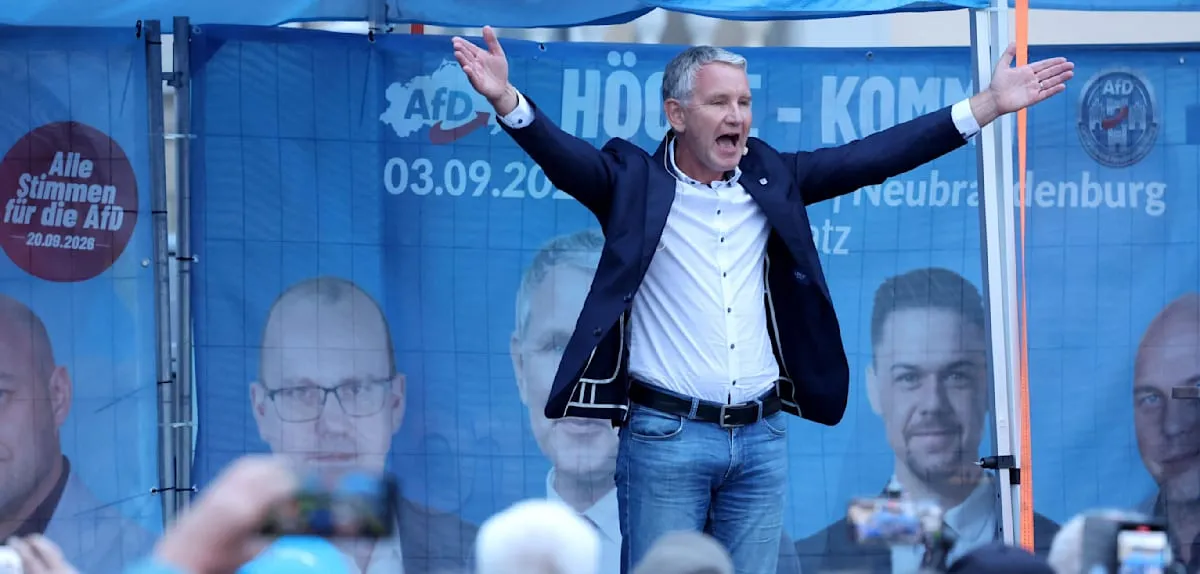
MECKLENBURG-VORPOMMERN – Bjorn Hocke, a central figure in the Alternative for Germany (AfD) party, sparked sharp controversy during a speech to hundreds of his supporters in Mecklenburg-Vorpommern. He declared Germany is now 'on the way to a new type of dictatorship,' accusing 'cartel parties' of being responsible. The incident, which occurred during a political campaign, was further exacerbated by police reports of two Hitler salutes after the event concluded.
Hocke's provocative claim was delivered at a campaign event attended by a large crowd of AfD supporters. This statement immediately drew public and media attention, given Germany's historical sensitivity to such rhetoric. Hocke consistently employs narratives that challenge political establishments and the prevailing democratic system.
In his speech, the politician from the state of Thuringia not only launched harsh criticism against the government but also explicitly targeted what he referred to as 'cartel parties.' This term typically refers to established parties that Hocke accuses of forming a political oligarchy, hindering popular participation, and eroding freedom of speech.
Hocke's rhetoric aligns with AfD's strategy, which frequently voices discontent with the German political system. The party claims that traditional parties have failed to represent the interests of the people and tend to collude to maintain power rather than serve society.
The statement about a 'new type of dictatorship' raises serious concerns among political observers and civil society. Many see it as an attempt to undermine the foundations of German democracy and provoke extreme polarization. Germany's dark history serves as a stark reminder of the dangers of rampant political polarization.
Furthermore, the incident of two Hitler salutes detected by the police after the rally added a negative mark to the event. The Hitler salute, or 'Hitlergruss,' is a forbidden symbol in Germany and a criminal offense referring to the Nazi period. This incident reinforced AfD's controversial image, even though the party officially rejects connections to right-wing extremism.
This incident also raises questions about the extent of free expression boundaries in political campaigns in Germany. The German government has strict laws to prevent the spread of extremist ideologies and symbols associated with totalitarian regimes.
Critics of AfD often accuse the party of deliberately using ambiguous rhetoric that allows its supporters to interpret extremist messages without directly breaking the law. This tactic often leads to intense debates about political ethics and a party's responsibility towards democracy.
Amidst this turmoil, AfD's popularity continues to show an upward trend in some regions, as seen in recent surveys ahead of the 2026 Sachsen-Anhalt election. This reflects the disillusionment of some voters with established parties and the appeal of the anti-establishment narrative offered by AfD.
This situation poses significant challenges for the German political landscape. Analysts predict that debates surrounding the definition of democracy and the limits of political freedom will intensify ahead of upcoming regional and national elections, with AfD as one of the main actors.
Editorial Insight: Bjorn Hocke's statement about Germany heading towards a 'new type of dictatorship' represents a significant escalation of rhetoric. The use of this phrase, coupled with the Hitler salute incident, not only creates political sensation but also fundamentally challenges the legitimacy of democratic institutions. It underscores AfD's strategy to position itself as the only alternative to a system they deem corrupt. The long-term impact is the potential erosion of public trust in the democratic process, while also prompting a more assertive response from other parties to defend Germany's constitutional values. The context of the 2026 elections will be a crucial stage for such narratives.