 Edward DP Situmorang
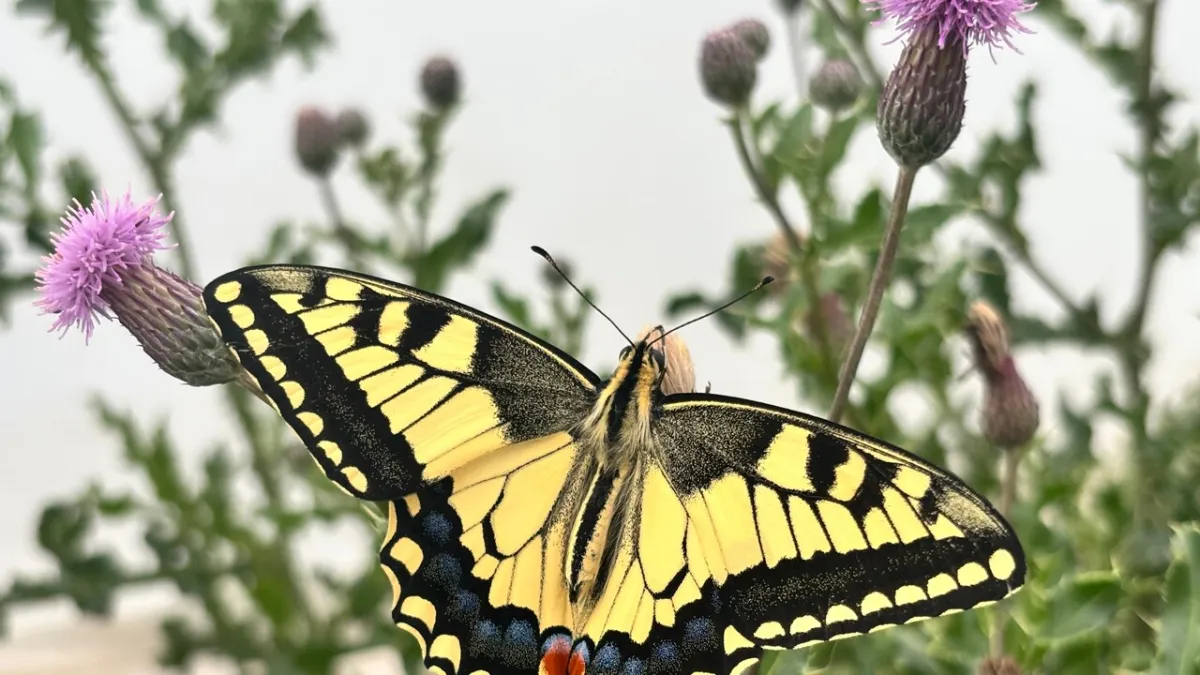
Jakarta – The scientific world is once again surprised by a revolutionary discovery revealing the self-defense mechanism of butterflies. Recent research in 2026 shows that these beautiful creatures cleverly utilize optical illusions, a combination of intricate wing patterns and dynamic flapping movements, to deceive and confuse their natural predators. This high-level camouflage strategy unveils a new chapter in our understanding of evolution and adaptation in nature.
Scientists, in a study published in a prestigious scientific journal, detailed how each flap of a butterfly's wings is not merely a means of flight, but an integral part of a visual display that disrupts perception. The synergy between striking patterns and rapid movements creates a visual effect that seemingly alters the insect's shape or location, making it difficult for predators to track its true position.
This phenomenon has long been a puzzle. How can a butterfly, often an easy prey, survive in harsh ecosystems? The answer now points to a sophistication of visual adaptation far beyond previous assumptions, cementing the role of illusion as a natural shield.
This research involved in-depth observations in natural habitats as well as controlled experiments in laboratories. By using high-speed imaging technology and motion analysis algorithms, researchers successfully broke down every visual element contributing to the optical illusion.
They found that certain butterfly species possess concentric circles or wavy lines on their wings. When these wings are flapped rapidly, the patterns appear to shift or flicker, creating a stroboscopic effect that confuses the eyes of predators.
Professor Aria Setiawan, an entomologist from the University of Indonesia who was not involved in the study but appreciated the findings, stated, 'This discovery is truly captivating. Butterflies are not only beautiful but also brilliant natural optical engineers. It changes our perspective on predator-prey interactions.'
As a result of this illusion, predators, such as birds or lizards, often fail in their initial attacks. The split second lost due to this confusion is enough for the butterfly to escape, a vital advantage in the struggle for life and death.
The potential applications of these findings are vast. From the development of more advanced military camouflage technology to the design of new materials capable of deceiving visual sensors, these principles can inspire innovation across various fields. This is a real example of how nature provides brilliant solutions that we can learn from.
This study also highlights the importance of preserving biodiversity. Every species, no matter how small, holds invaluable evolutionary secrets. The protection of butterfly habitats becomes even more crucial so that other mysteries of nature can continue to be uncovered.
Editorial Insight:
The discovery of optical illusions in butterflies is not just fascinating scientific news; it is a reminder of nature's adaptive intelligence that often escapes our notice. Its implications extend from evolutionary biology to potential material engineering and defense applications. Moving forward, we might see applications of this principle in sensor technology or even adaptive architectural design. However, most fundamentally, it underscores the urgency of environmental conservation, as every species is a living library of remarkable survival strategies.