 Gabriella
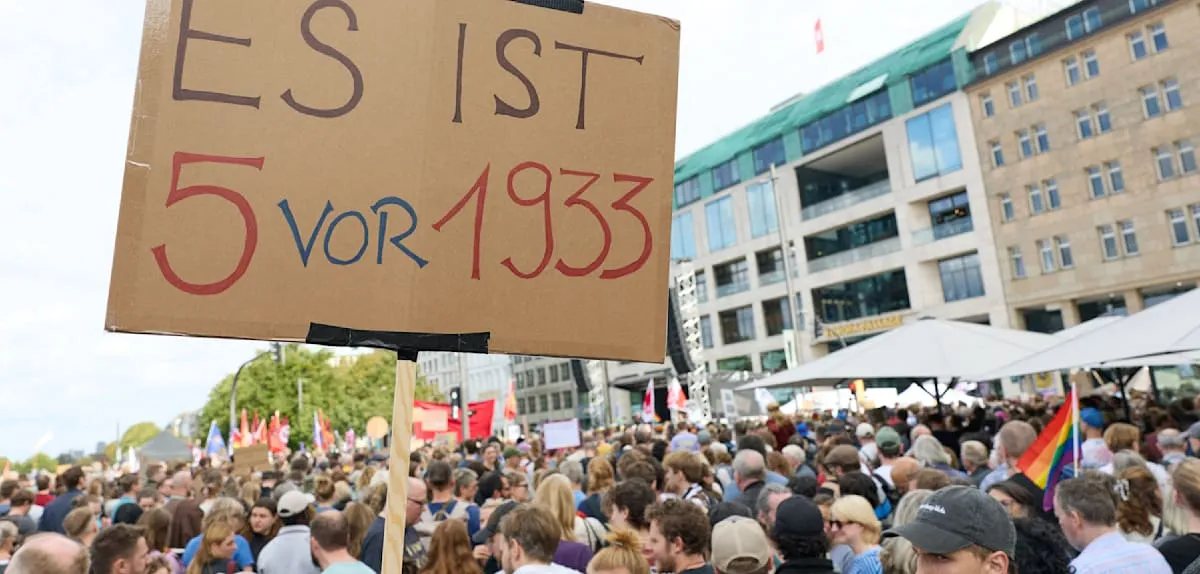
HAMBURG – Prominent political scientist Kai-Uwe Schnapp recently warned that attempts to ban the Alternative for Germany (AfD) party would be a significant strategic error, potentially jeopardizing German democracy. This warning emerges amidst a wave of mass demonstrations, including in Hamburg, demanding an investigative process into the party, even as Schnapp argues such a move could paradoxically strengthen AfD by excluding the voices of over a quarter of voters from public discourse.
In an exclusive interview, Schnapp emphasized that banning a political party with significant public support is not only controversial but also carries high risks. According to him, such a decision would close the door to dialogue for a large segment of citizens and create a deep sense of injustice among AfD constituents.
If more than a quarter of voters are excluded from political discourse because their chosen party is banned, it will not solve the problem. On the contrary, it will fuel anti-establishment sentiment and further strengthen AfD in the eyes of its supporters as victims of the system, Schnapp stated, highlighting the unintended consequences of such a ban.
Schnapp's views come as public calls to review AfD's constitutional status intensify. In various German cities, tens of thousands of citizens have taken to the streets, voicing their concerns about the right-wing extremist rhetoric and policies promoted by AfD. The protest in Hamburg is one of the latest manifestations of public demand for an official investigative procedure into the party.
These demonstrations are not isolated phenomena. Over recent months, Germany has indeed been agitated with tens of thousands of its citizens taking to the streets to oppose right-wing extremism. Protesters demand that the government seriously consider the possibility of banning AfD, or at least initiate a process to evaluate whether the party violates the constitution.
However, Kai-Uwe Schnapp argues that the focus should be on how to combat AfD's ideology in the open political arena, rather than through drastic legal channels. He believes that robust public debate and convincing arguments are more effective ways to undermine the party's appeal.
AfD itself has seen a significant increase in its popularity, shaking German politics and threatening traditional coalitions. This growth in support highlights the challenges faced by established parties in attracting voters who feel marginalized or disillusioned with government policies.
German history shows that banning political parties is an extreme and rarely taken step. After World War II, only two parties were ever banned by the Federal Constitutional Court: the Sozialistische Reichspartei (SRP) in 1952 and the Kommunistische Partei Deutschlands (KPD) in 1956. The legal standard for a ban is very high, requiring proof that a party actively aims to undermine or abolish the free democratic basic order.
Several political figures and legal experts also echo Schnapp's concerns, emphasizing the importance of maintaining the principle of political pluralism. They worry that banning AfD, while perhaps satisfying some of the public, would erode the foundations of democracy and provide a platform for extremist groups to operate underground.
The government and other parties in Germany currently face a complex dilemma: how to respond to the rise of AfD without violating the democratic principles they uphold. Even new parties like BSW, despite ideological differences, have rejected the possibility of coalition with AfD, illustrating how political divisions in Germany are intensifying.
Kai-Uwe Schnapp's warning serves as an important reminder for policymakers and the wider public. Democracy is not just about protecting the majority, but also about guaranteeing minority rights and inclusiveness in political discourse, even for unpopular voices. Strategic decisions regarding AfD will shape Germany's political landscape for years to come.
Editorial Insight:
Schnapp's statement underscores the paradox of banning a party within a democratic system: an attempt to protect democracy can ironically erode it. Instead of curbing extremism, such a move risks further polarization and creates a martyr complex for AfD. The real challenge for German democracy is to confront and defeat extremist ideologies through the strength of argument and inclusive policies, not through a heavy legal hand that could trigger unforeseen consequences and deepen public distrust in institutions. Germany's political future hinges on how this challenge is wisely addressed.