 Debby Wijaya
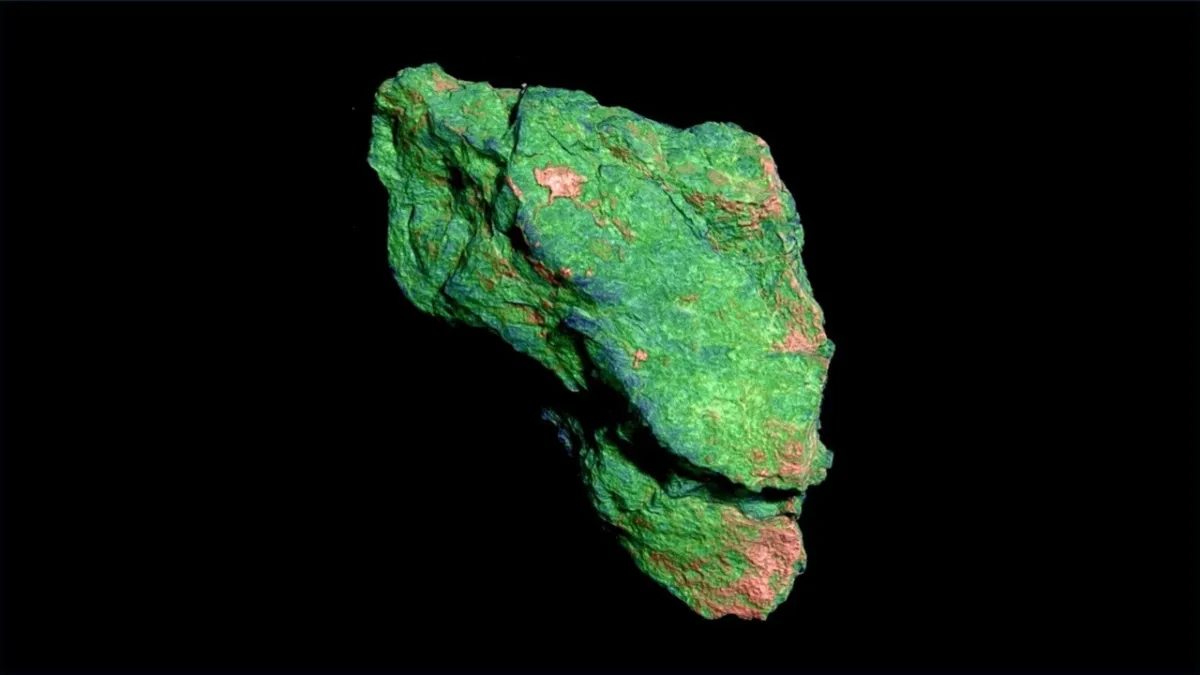
Geneva – The recent discovery and in-depth analysis of a peculiar space rock, named Hypatia, has profoundly shaken scientific understanding of our Solar System's formation. This cosmic stone, found in the Libyan Desert, possesses a mineral composition vastly different from other meteorites ever studied, unveiling a far more complex and unexpected early history of our universe.
Researchers involved in the study, published in a prestigious journal, revealed that Hypatia is no ordinary meteorite. Its structure and chemical content indicate it formed from an ancient cloud of gas and dust distinct from the material composing conventional meteorites. The implications of this discovery are highly significant for astrophysics and planetology.
Scientists have historically relied on meteorite analysis to reconstruct the conditions of the young Solar System. These meteorites, typically asteroid fragments, exhibit a relatively uniform chemical signature, suggesting an origin from a homogeneous protoplanetary disk. However, Hypatia radically breaks this pattern.
Careful analysis of Hypatia shows the presence of exotic elements and anomalous isotope ratios. These features cannot be explained by standard Solar System formation processes, raising critical questions about the existence of material from outside the early Solar Nebula or catastrophic cosmic impact events in the past.
Professor Jan van Niekerk, a planetary geology expert from the University of Zurich and part of the research team, stated, Hypatia is an extraordinary artifact that forces us to rewrite some of the most important chapters in the history book of the Solar System. Its composition suggests unique pockets of matter, perhaps from other stars or even supernovae, coalescing within our protoplanetary disk.
This mysterious rock was first discovered in 1996 and has undergone a series of advanced tests in various international laboratories. Each test consistently showed characteristics never before seen in extraterrestrial material originating from our Solar System.
This discovery fuels speculation that the Solar System may have formed from a more heterogeneous mixture of materials than previously assumed. It opens up the possibility of additional material sources contributing to the birth of planets, including Earth.
Astrophysicists now face the challenge of revising their Solar System formation models to accommodate the findings from Hypatia. It is plausible that our protoplanetary disk once experienced mixing with material from different interstellar environments, adding new complexity to cosmic evolution models.
Hypatia's existence serves as strong evidence that the universe holds many secrets waiting to be unveiled. Every rock fragment from space has the potential to change how we understand our place in this vast cosmos. It is a reminder of the infinite diversity of cosmic matter.
Further research on Hypatia and similar rocks is crucial to confirm these new hypotheses and fully explore their implications. Details of how this exotic matter integrated into the early Solar System will be a focus of future scientific investigation.
Editorial Insight: The discovery of Hypatia is not merely a scientific news item; it is a paradigmatic leap with the potential to rewrite astronomy textbooks. It affirms that our cosmic origin models are inherently dynamic and require constant revalidation by empirical evidence. Its long-term implications could extend to the search for extraterrestrial life, as understanding the initial composition of a star system is key to identifying conditions supportive of life.