 Robert Andrison
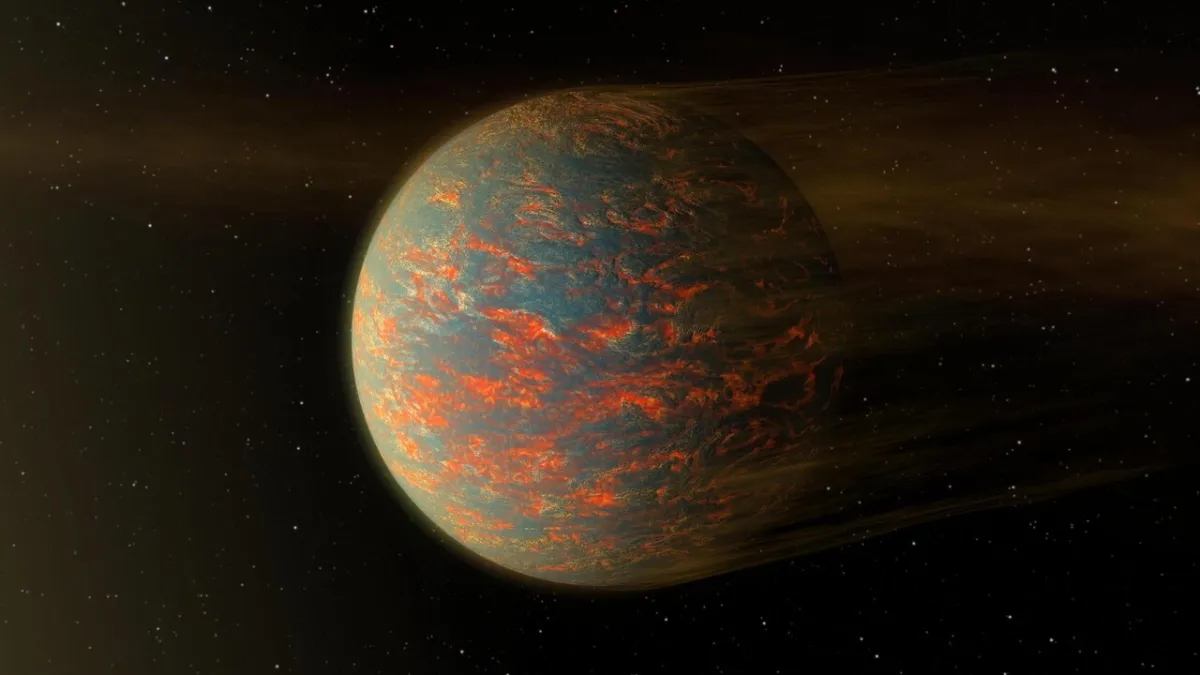
JAKARTA – A monumental discovery recently announced by the global astrophysics community has shaken the realm of science. Scientists have successfully identified an exoplanet strikingly similar to primordial Earth, a unique lava world distinguished as the coldest ever recorded while also possessing an atmosphere. This finding is more than just an addition to the list of planets in the universe; it opens new horizons in our understanding of planetary formation and evolution, and even the potential for life beyond Earth.
This as-yet-unpopularly-named planet, scientifically classified as a super-Earth exoplanet, exhibits extreme conditions. Although termed a lava world, its temperature is significantly lower than other detected lava exoplanets, making it a fascinating anomaly for researchers. Its surface, believed to be solid yet geologically active, likely presents a landscape of slowly cooling molten rock.
The presence of an atmosphere is a crucial point in this discovery. An atmosphere is key to sustaining life on Earth and often serves as an indicator of a planet's potential habitability. While the exact composition of this planet's atmosphere remains a subject of intensive research, its existence suggests active geological processes capable of maintaining a gaseous envelope around it, a rare phenomenon for a lava world.
This discovery was published in a leading scientific journal following a series of observations using the latest generation of space telescopes. An international research team, comprising astrophysicists from various prestigious institutions, analyzed complex spectroscopic data to confirm the planet's unique characteristics. The exoplanet's location is relatively close to its host star, but its orbital configuration allows for significant cooling.
Its resemblance to primordial Earth, billions of years ago when our planet was in its early stages of formation, is the most captivating aspect. Our Earth was once also an extremely hot world, often referred to as a lava Earth during the Hadean Eon. Comparative studies between this exoplanet and models of early Earth could provide invaluable insights into how our planet evolved from a fiery ball into an oasis of life.
This discovery also strengthens theories about planetogenesis, the process of planet formation from gas and dust disks around young stars. The extreme conditions and detected atmosphere challenge some previous assumptions about the necessary conditions for a planet to retain an atmosphere or cool down to such an extent.
The successful identification of a planet of this size with detailed atmospheric characteristics also highlights advancements in space observation technology. More sensitive instruments and increasingly sophisticated data analysis methods allow scientists to see and characterize distant worlds with previously unimaginable precision.
Despite this exciting discovery, future research challenges remain substantial. Scientists plan to conduct further observations to gain a deeper understanding of the atmospheric composition, the geological nature of the surface, and whether any processes could support prebiotic molecules or conditions more conducive to life.
The discovery of exoplanets, especially those exhibiting unique characteristics like this one, is an integral part of humanity's quest to answer a fundamental question: Are we alone in the universe? Each discovered exoplanet, with all its uniqueness, is a piece of the puzzle in the grand cosmic picture.
The finding of the coldest lava world with an atmosphere reaffirms that the universe is far more diverse and mysterious than we ever imagined. It sparks our collective imagination and pushes the boundaries of scientific knowledge.
Editorial Insight: The discovery of a primordial Earth-like exoplanet with an atmosphere is a significant leap in astrophysics. Its greatest implication lies in our understanding of terrestrial planet evolution and the essential conditions for the emergence of life. If even the coldest lava world can retain an atmosphere, this expands the range of conditions that might support life beyond Earth, albeit in vastly different forms. It also indicates that space exploration efforts with increasingly advanced technology will continue to yield surprises, which may one day lead us to definitive answers about the existence of other life in the universe.