 Gabriella
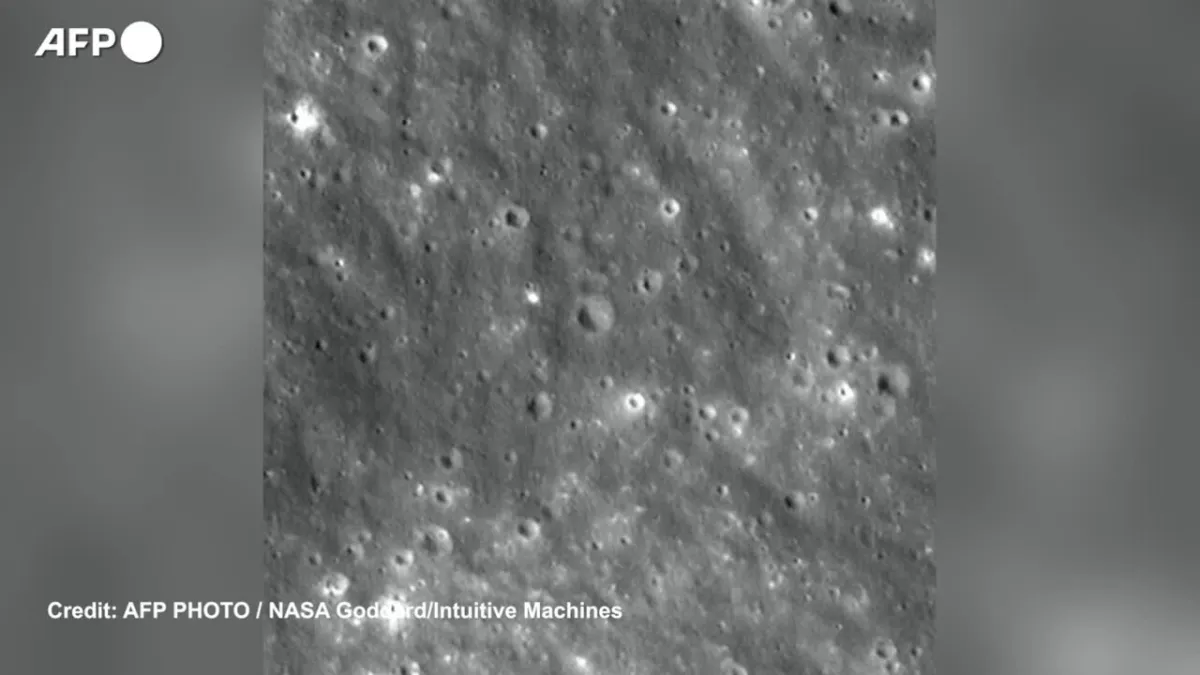
WASHINGTON – The National Aeronautics and Space Administration (NASA) recently released striking images revealing the presence of a new double crater on the Moon's surface. This discovery has been definitively linked to the impact of a rocket booster owned by private space company SpaceX in March 2022, sparking widespread discussion about the impact of human activities in outer space. The visual data was captured by the Lunar Reconnaissance Orbiter (LRO), which operates in orbit around Earth's natural satellite.
The resulting crater is unusual, comprising two overlapping craters approximately 18 meters and 16 meters in diameter, rather than a single impact site. This unique formation suggests that the object hitting the lunar surface may have had an uneven mass distribution at each end.
The rocket in question was part of a SpaceX Falcon 9 rocket. The booster was supposed to either return to Earth's atmosphere or completely escape the Earth-Moon gravitational system after completing its mission to launch the Deep Space Climate Observatory (DSCOVR) satellite in 2015. However, a failed maneuver turned it into space junk floating uncontrollably.
The LRO probe, which has been orbiting the Moon since 2009, successfully captured this crucial moment. High-resolution images show the area before the incident and the dramatic landscape after the impact. LRO's ability to document even the smallest changes in the lunar landscape is vital for our understanding of the extraterrestrial environment.
Rocket impacts on the Moon are not unprecedented, but this marks the first time a private company's booster accidentally caused a significant crater. Typically, craters are formed by meteoroids or intentional missions. The characteristic double crater also adds to the uniqueness of this event.
Scientists from NASA's Jet Propulsion Laboratory (JPL) and various other institutions are now analyzing the data to further understand lunar geology and impact mechanics. This research is expected to provide new insights into the internal composition of rockets and how man-made materials interact with the surface of celestial bodies.
This incident once again highlights the increasingly worrying issue of space debris. With the growing number of rocket and satellite launches, the risk of collisions and contamination of the space environment also increases. The international community continues to seek mitigation solutions.
While there has been no direct official statement from SpaceX regarding this crater, the company has previously stated its commitment to responsible space practices. Nevertheless, this event will undoubtedly add pressure for stricter safety standards.
The discovery of this crater is also relevant for future lunar exploration missions, including NASA's Artemis program, which aims to return humans to the Moon. Understanding the frequency and types of impacts can assist mission planners in selecting safe landing sites and building robust infrastructure.
Planetary protection, the concept of safeguarding celestial bodies from terrestrial microbial contamination and vice versa, becomes increasingly complex. Although this impact is physical, it serves as a reminder of the need for stringent regulations in all space activities.
Every impact on the lunar surface provides us with a rare 'window' into geological processes and the evolution of celestial bodies. This double crater, in particular, is extremely fascinating for study, said Dr. Karina Chandra, an astrophysicist from Gadjah Mada University, commenting on the discovery.
Thus, the latest images from LRO are not just visual discoveries. They are tangible proof that the footprint of human activity has now reached the Moon on an unplanned scale, serving as an important reminder for the sustainability of space exploration.
Editorial Insight: The discovery of the double crater caused by the SpaceX rocket marks an evolution in the discourse surrounding the environmental impact of space activities. It is no longer solely about defunct satellites in Earth's orbit, but also about man-made objects modifying the surface of other celestial bodies. This incident may catalyze a stronger push for international regulations governing rocket disposal and the protection of celestial bodies, especially as various nations and private companies pursue increasingly ambitious lunar exploration missions in the coming years.