 Chris Robert
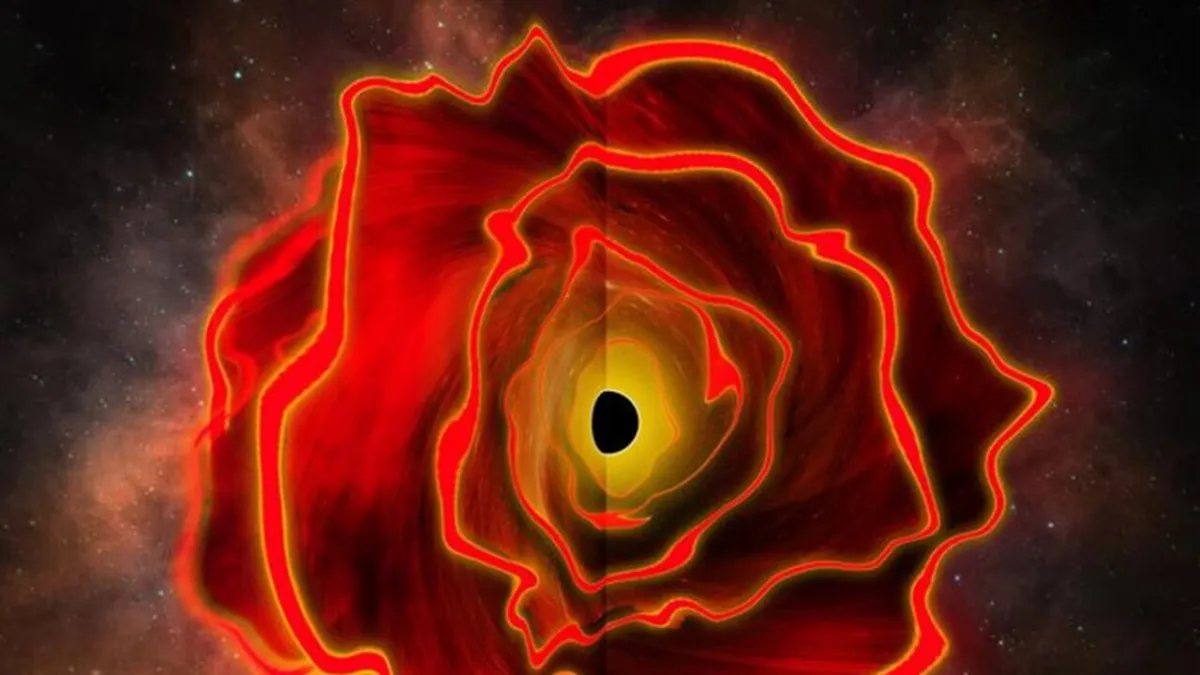
GENEVA – Global astrophysics scientists have announced a phenomenal discovery: the existence of a 'cosmic monster,' a hybrid entity between a star and a black hole. This finding is expected to unravel the mystery behind the peculiar red dots observed by the James Webb Space Telescope (JWST) over the past few years. The discovery, published in a leading scientific journal earlier this week, has the potential to revolutionize our understanding of the universe's evolution.
The research was spearheaded by an international astrophysics team from the European Space Agency (ESA) and several prominent research institutions in the United States and Japan. They described this new object as a hybrid, a term reflecting the combined characteristics of two of the most extreme objects in the cosmos.
Through an analysis of spectral data and high-resolution images gathered by the Webb Telescope, researchers identified the object's unique signature. The data indicates that this celestial body emits light like a star but possesses a mass and gravitational pull consistent with a mini black hole.
This mysterious object offers the most compelling explanation to date for the red dots phenomenon frequently observed in the early universe by the Webb Telescope. These dots were previously an enigma, fueling various speculations about the existence of ancient galaxies that did not conform to standard cosmological models.
Since JWST became fully operational in 2022, its infrared capabilities have opened a new window into the universe's past. However, several observations of distant objects, particularly bright red dots in early galaxies formed only hundreds of millions of years after the Big Bang, raised profound questions about star and galaxy formation processes.
Previously, theories suggested that these red dots might be extremely dense dwarf galaxies or the first massive stars to form. However, no single model could consistently explain their unique light spectrum and distribution.
The discovery of this cosmic monster indicates the possibility of previously unimagined evolutionary pathways for celestial bodies. It might represent stars collapsing into black holes in unusual ways, or even black holes 'stealing' stellar material without fully consuming the star, creating a stable transitional entity.
This is a monumental breakthrough, stated Professor Elena Petrova, head of the research team from ESA, in a virtual press conference held yesterday. This object is not merely an anomaly, but a vital clue that reshapes our narrative about how the early universe developed and how matter evolved under extreme conditions.
The impact of this discovery is expected to extend to fundamental physics and the search for extraterrestrial life. Understanding the formation mechanisms and behavior of these hybrid entities will help scientists refine cosmological models and galaxy evolution theories.
Editorial Insight: The discovery of this hybrid cosmic entity is more than just adding another object to the universe's catalog; it represents a paradigm shift. It compels us to re-examine fundamental assumptions about star and black hole evolution, providing a new framework for interpreting complex data from future generation telescopes. Its implications for early galaxy formation theories are immense, promising a new era of more focused and profound cosmic exploration.