 Demian Sahputra
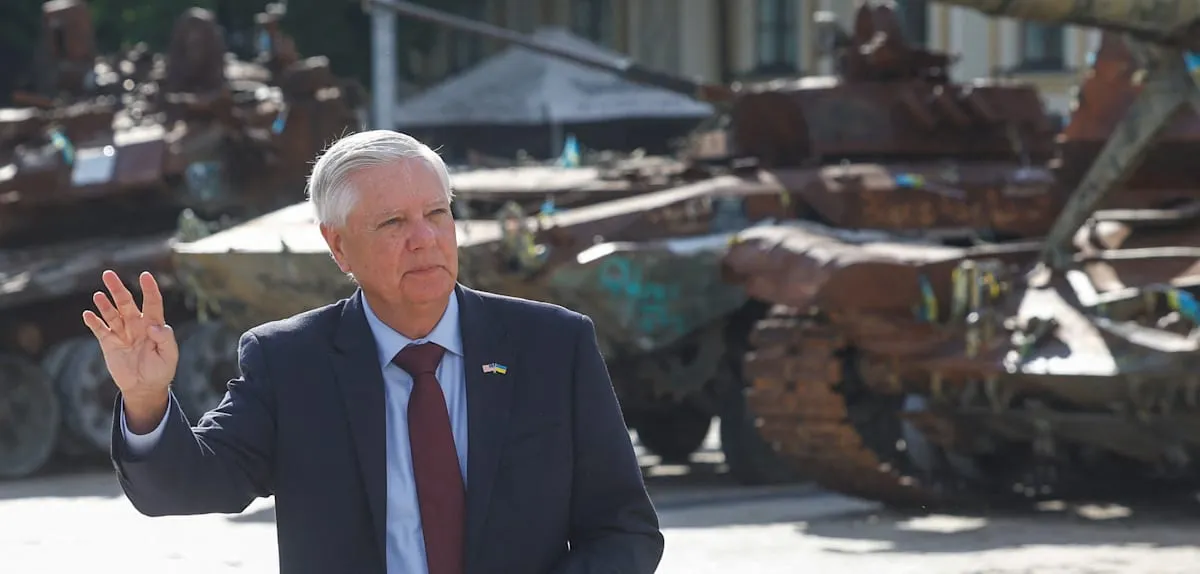
WASHINGTON D.C. — The political world of the United States was shocked by the passing of Senator Lindsey Graham on Friday, 2026. The sudden departure of this vocal Republican politician immediately raises significant questions about the continuation of a crucial economic sanctions package against Russia, an initiative he had vigorously advocated for months. The consensus that had been built now falters, leaving deep uncertainty about the direction of Washington's foreign policy on the global stage.
Senator Graham was known as one of the sharpest critics of Kremlin policy, consistently pushing efforts to undermine Russia's financial capabilities. His main vision was to design comprehensive sanctions specifically aimed at drying up Moscow's main sources of income, a strategic move to curb its aggression in the international arena.
On the same day his passing was announced, Graham had just claimed a significant breakthrough in negotiations related to the sanctions package. This statement, which initially brought new hope, now turns into a bitter irony that hangs the fate of this strategic policy in the balance.
The sudden death of a central figure like Graham has the potential to create a leadership vacuum that will be difficult to fill quickly. Complex legislative processes, especially concerning sensitive geopolitical issues, heavily rely on the personal influence and advocacy capabilities of senior legislators. Without a figure as strong as Graham, the momentum that has been built risks slowing down or even halting.
Analysis from international political observers indicates that Graham's loss will be felt especially in the Senate Foreign Relations Committee, where he often served as an architect of hardline policies against adversaries of the United States. His negotiating prowess and his ability to rally bipartisan support were vital elements in advancing such an agenda.
The Russia sanctions package championed by Graham was not merely a rhetorical response. It was a structured effort to fundamentally alter Russia's economic calculations, targeting key sectors such as energy and finance that form the backbone of the country's power. Without close oversight and relentless drive, its implementation might not be as effective as expected.
The geopolitical conflict between the United States and Russia has intensified over the past few years, with sanctions being one of Washington's primary tools for exerting pressure. However, the effectiveness of sanctions is often debated, and a strong coalition and unwavering political will are needed to ensure their maximum impact.
Concerns about the 'Winds of War' once again threatening the world in 2026, as warned by Pope Francis, add to the urgency of this US foreign policy. Sanctions against Russia are seen as part of a larger strategy to prevent a broader escalation of global conflict. (See also: Pope Francis Warns: 'Winds of War' Threaten the World Again 2026).
The situation in Ukraine, for instance, continues to be a flashpoint driving ongoing tensions. Military escalation, as depicted in the report Fierce Escalation! Russia Bombards Kyiv and Sumy, Ukraine's Defenses Helpless, further strengthens the argument for stricter sanctions policies.
The fundamental question now arising is who will take over the baton from Graham. A politician with similar credibility and influence is needed to ensure the sanctions package not only passes Congress but is also implemented with the same resolve.
The US Senate must now act quickly to address this vacuum, either through appointing a replacement in committee leadership or by galvanizing support from other senators with similar views. However, internal political complexities in Washington often slow down such processes.
Some parties are even beginning to speculate that Graham's death might be exploited by more moderate factions or those leaning towards diplomatic approaches to review the effectiveness and long-term implications of very harsh sanctions. This could determine the future direction of US policy towards Russia.
This sudden death is not only a loss for the Republican Party but also for the overall architecture of US foreign policy. Graham's legacy as a staunch defender of American principles will be remembered, but the challenge lies in how to continue the fight he began.
The impact of this event extends beyond Washington. Allies of the United States in Europe and Asia, who rely on US leadership in confronting Russia, will closely monitor how the administration of President Joe Biden and Congress will respond to this critical situation.
This uncertainty potentially provides an opening for Russia to exploit divisions or weaknesses in the international consensus. A pause in sanctions pressure could be used by the Kremlin to strengthen its position, both economically and strategically.
Thus, the passing of Senator Lindsey Graham is not just news of sorrow. It is a crucial moment that could reshape global geopolitical dynamics, especially in the relationship between the United States and Russia, in 2026 and beyond.