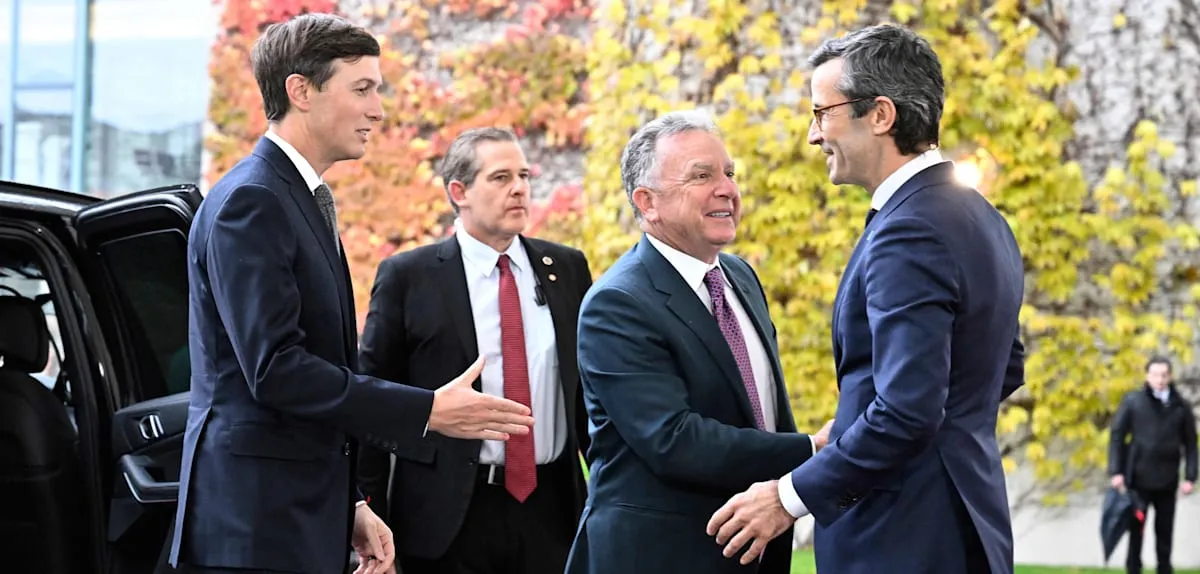
BERLIN – Diplomatic tensions in the heart of Europe have reached a crescendo. Special envoys for United States President Donald Trump, Jared Kushner and Avi Witkoff, arrived in Berlin on Monday [date, month 2026], signaling the commencement of a crucial summit to discuss the future of Ukraine. This summit aims to formulate a framework for territorial negotiations, emphasizing the establishment of demarcation lines based on current military control on the battlefield.
The arrival of the US delegation, led by two key figures in Trump's circle, underscores the significant geopolitical weight of this peace initiative. Kushner, President Trump's son-in-law, and Witkoff, known for his negotiation capabilities, are expected to bring fresh perspectives in seeking a solution to the protracted conflict.
The main agenda of the meeting is to discuss a proposal for territorial negotiations that will use the current frontline as the starting point for discussions. This represents a pragmatic, yet potentially controversial, approach given Ukraine's ongoing claims of sovereignty over its entire territory.
A planned meeting with German Chancellor Friedrich Merz is also a focal point. This meeting is crucial for aligning positions between the United States and Germany, two decisive powers in supporting Ukraine and mediating the conflict. This dialogue will explore potential European support for the negotiation proposals being put forward.
Ukrainian President Volodymyr Zelenskyy is also expected to attend, or at least be represented by high-ranking officials. His presence is vital to legitimize any agreement reached and to reaffirm Kyiv's position at the negotiating table.
The conflict in Ukraine, rooted in annexation and aggression, has caused immense humanitarian and geopolitical repercussions. Previous peace efforts have often stalled due to fundamental differences regarding sovereignty and territorial integrity.
The 'frontline as a baseline' approach marks a significant shift in negotiation strategy. This could be seen as an attempt to break the deadlock, though it carries the risk of legitimizing territorial occupation.
Anonymous sources indicate that discussions will involve complex aspects, including the status of occupied territories, humanitarian corridors, and potential prisoner exchanges. The success of the negotiations will heavily depend on the willingness of all parties to compromise.
If these territorial negotiations succeed, it could be a crucial first step towards broader de-escalation. However, failure could prolong the conflict and further complicate efforts to restore regional stability. The economic impact is also significant. Stability in Ukraine would influence global energy markets and supply chains.
This Berlin summit takes place amidst a complex global geopolitical dynamic. On one hand, there are regional efforts for stability, as seen in initiatives like peace dialogue on the Korean Peninsula. On the other hand, sensitive issues such as military technology development and nuclear threats remain a shadow. Nuclear issues were also raised by Trump in another crucial summit, highlighting the urgency of global stability.
The international community anxiously awaits the outcome of this Berlin Summit. Hopes for a peaceful resolution are high, though the reality of complex negotiations requires a cautious and patient approach. Delegates will work diligently over the coming days to develop a framework acceptable to all parties, considering the long-term implications for European security.
Editorial Insight: The presence of Jared Kushner and Avi Witkoff as President Trump's envoys at the Ukraine Summit in Berlin underscores the US administration's effort to leave a significant diplomatic mark. The approach of using the current frontline as the basis for territorial negotiations is a bold move that could break the stalemate, but also risks legitimizing the status quo resulting from the conflict. The success of this initiative will depend on the ability to balance on-the-ground realities with international legal principles and state sovereignty. If successful, this could be a blueprint for resolving other frozen conflicts. However, if it fails, the credibility of peace efforts will be further eroded.