 Stefani Rindus
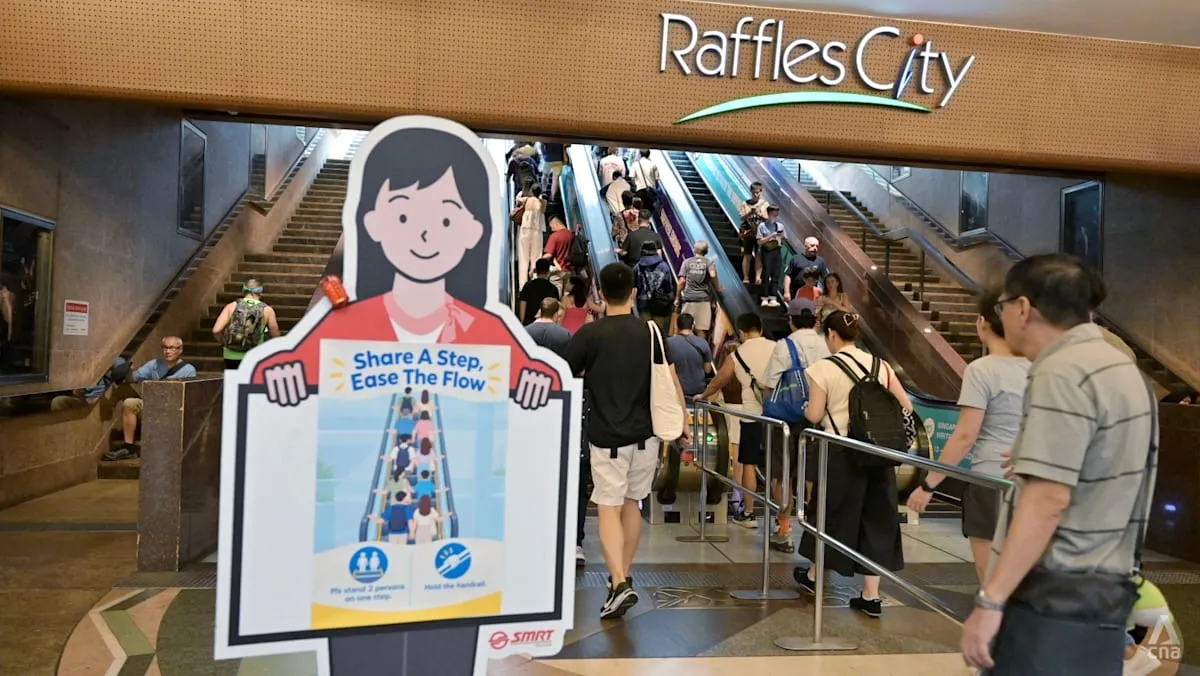
SINGAPORE – Singapore's public transport operator, SMRT, has launched a new escalator usage scheme trial at City Hall MRT Station, an ambitious initiative to address congestion and enhance commuter movement efficiency. However, efforts to alter passengers' long-standing habit of standing on the left side while leaving the right for walking are facing significant resistance in 2026.
This step was taken after extensive observations revealed that the widespread 'keep left' habit significantly reduces the effective capacity of escalators and slows down passenger flow. This phenomenon has been a long-standing debate in various metropolitan cities relying on efficient public transport systems.
In the trial conducted at one of its busiest stations, SMRT encourages commuters to stand on both sides of the escalator, while still providing an option for those wishing to walk to use the right side. The objective is to distribute passenger load evenly and accelerate the total travel time.
According to CNA's observations at City Hall MRT Station, commuters who chose to walk on the right-hand steps completed their escalator journey in approximately 20 seconds. This is significantly faster compared to the 30 seconds required by those who opted to stand still on the left side. A 10-second difference per journey, multiplied by millions of commuters daily, has the potential to generate colossal collective time savings.
Despite the highly promising efficiency data, the primary challenge lies in behavioral adaptation. Social habits deeply ingrained for decades, such as keeping the left side for standing and the right side for express travel, are not easy to change. People tend to be reluctant to adapt to changes that feel minor but disrupt their daily routines.
SMRT stated that this trial is part of their continuous evaluation to optimize operations and passenger comfort. They understand that change requires time and massive public awareness campaigns. The current focus is on collecting further data regarding public response and operational impact.
We strive to find the best solutions for everyone. Efficiency is not just about speed, but also about capacity and safety, said an SMRT spokesperson, emphasizing their commitment to service improvement.
The potential positive impact of this scheme is substantial. If successfully implemented widely, not only will individual travel times decrease, but platform congestion can also be minimized, especially during peak hours. This will enhance the travel experience for all MRT users.
Similar approaches have been trialed in several other global cities, but with varying results. For instance, cities in Japan have very strong stand on left or stand on right cultures depending on the region, but most still maintain a lane for walking. On the other hand, some European cities have begun educating passengers to stand on both sides for safety and capacity reasons.
Urbanization and social psychology experts highlight that public behavioral change requires a combination of education, supportive environmental design, and consistent enforcement. Humans are creatures of habit. To change established routines, clear incentives and continuous communication are needed, explained Dr. Anya Sharma, an urban sociologist.
Therefore, the success of this SMRT initiative depends not only on technical efficiency but also on the authority's ability to effectively educate and convince millions of commuters of the long-term benefits. Comprehensive public campaigns and clear signage on every escalator will be key.
Some interviewed commuters showed diverse responses. Some expressed openness to new ideas for efficiency, while others found it difficult to forget what is already customary or worried about potential new confusion and awkwardness on escalators.
The implementation of such a policy could set an important precedent for future public transport planning, not only in Singapore but also in other cities facing similar challenges. It demonstrates the importance of adapting infrastructure and user behavior to maximize the potential of existing facilities.
The transport authority's hope is that this trial will provide valuable insights and, if successful, serve as a model for wider implementation. The goal is to create a public transport ecosystem that is not only fast but also smooth and convenient for every citizen.
Editorial Insight: The SMRT escalator trial in Singapore is not merely a change in physical rules but a complex social experiment. It highlights the dilemma between commuter tradition and efficiency innovation. The success of this initiative will depend on a clever communication strategy and SMRT's ability to slowly but surely guide its millions of citizens towards new behavioral adaptations, a precedent worth observing by major cities worldwide.