 Angel Doris
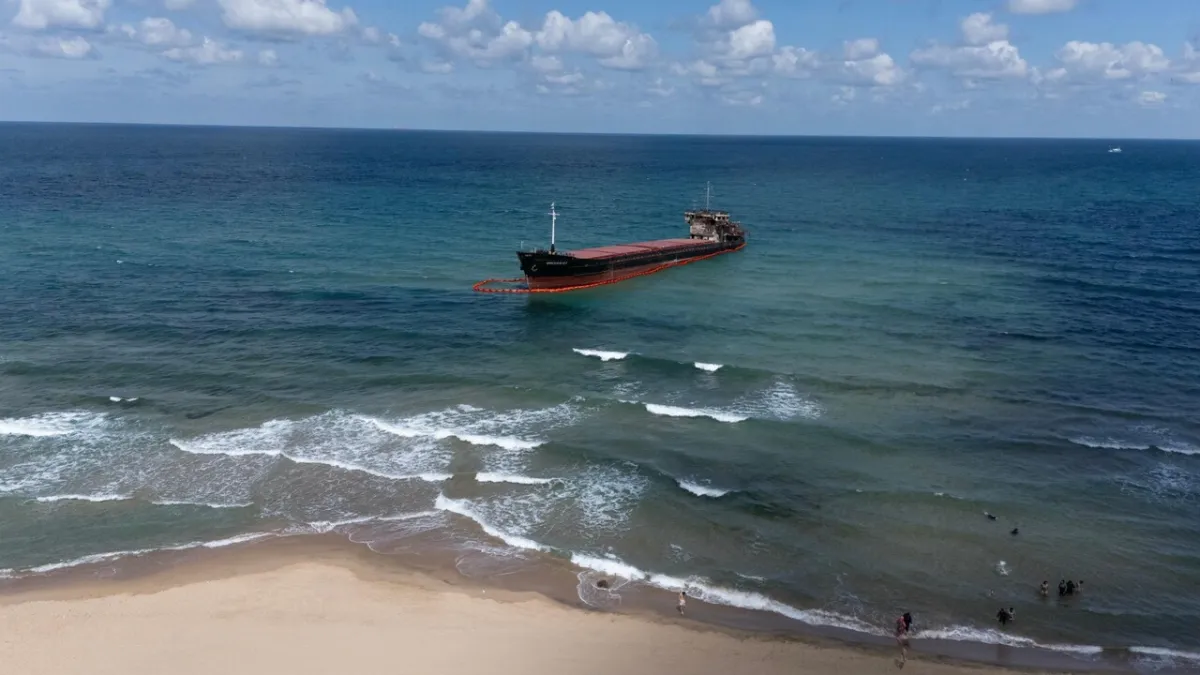
SOFIA – Early this morning, the Black Sea once again bore witness to an escalation of the global conflict after Bulgaria reported two merchant ships struck by drone attacks off its coast. This tragic incident resulted in one ship sinking entirely, while the fate of its entire crew remains unknown, sparking international concern for maritime safety.
The Bulgarian Ministry of Defense, in its official statement, confirmed that the attack occurred overnight in international waters near their exclusive economic zone. Initial reports indicated that both vessels, whose identities and flags have not been fully disclosed, were simultaneously attacked by unmanned units. One ship managed to send a brief distress signal before contact was lost.
Search and rescue operations were immediately launched by Bulgarian maritime authorities in cooperation with neighboring countries. However, unfavorable weather conditions and the vast search area complicated evacuation efforts. The primary focus is currently on finding the missing crew, although hopes are diminishing with time.
This incident adds to a long list of maritime violence in the Black Sea, which has become an indirect battlefield between Ukraine and Russia. The escalating use of drones, both aerial and naval, has changed the dynamics of the conflict, making it increasingly unpredictable and dangerous for civilian shipping. Readers can understand more about similar incidents through our previous report: Black Sea Gripped: Drone Attack Sinks Cargo Ship, One Ablaze.
Concurrently, tensions on the ground front have also intensified. On the same night as the drone attacks in the Black Sea, Kiev launched a massive attack on the Moscow region, resulting in two casualties and significant damage to civilian infrastructure. This attack marks an increase in intensity in the Russian capital, showing that Ukraine is becoming bolder in targeting strategic centers.
In response to Kiev's attack, the Russian military promptly retaliated. A vital bridge in Zaporizhia, Ukraine, was targeted by a precise Russian airstrike, injuring five civilians and damaging critical supply lines. This exchange of attacks confirms an unending cycle of violence, with civilians continuing to be the primary victims.
The government of Bulgaria has called for restraint from all warring parties, reiterating the importance of protecting international shipping lanes and the safety of seafarers. A spokesperson for the Bulgarian Ministry of Foreign Affairs stated, Security in the Black Sea is our top priority. We urge all parties to respect international law and avoid actions that could threaten civilian navigation.
The international community, including the United Nations, has expressed deep concern over this incident. The UN Secretary-General called for a thorough investigation and urged an end to all hostile acts that endanger civilians and vital trade routes. This crisis is also an urgent agenda item for an emergency UN Security Council meeting scheduled for next week.
Military analysts note that drone attacks on merchant ships indicate an expansion of the conflict zone into international waters previously considered relatively safe. This tactic not only causes material losses but also intimidates commercial shipping, potentially disrupting global supply chains and drastically increasing maritime insurance costs.
The repercussions of this incident are not only felt in the maritime sector. Prices of wheat and oil commodities, largely transported via the Black Sea, are expected to experience significant volatility in global markets. Investors and commodity traders are closely monitoring the situation, concerned about a recurrence of previous supply crises.
Editorial Insight: The incident of a ship sinking and crew going missing in the Black Sea due to a drone attack is a stark warning to the global community. This is not merely a material loss, but an indication that modern warfare is increasingly blurring the lines between combatants and non-combatants, as well as between war zones and neutral waters. Without strong diplomatic intervention and the enforcement of international maritime law, the risk of destabilization in this vital shipping lane will continue to rise, threatening the global economy and innocent human lives.