 Angela Stefani
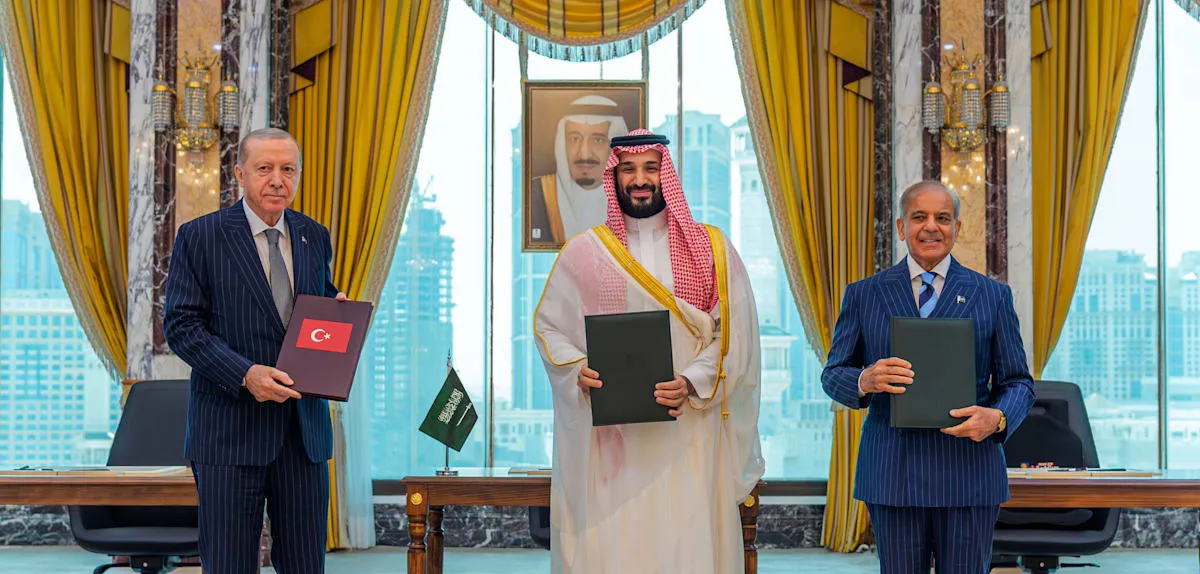
RIYADH – Saudi Arabia, Pakistan, and Turkey surprisingly announced the formation of a new defense alliance, modeled after the North Atlantic Treaty Organization (NATO), in early 2026. The agreement, dubbed the “Mecca Pact,” fundamentally alters the regional security landscape, establishing that an attack on one member state will be considered an attack on all members of the pact, a core principle of collective defense.
This declaration comes amidst escalating global geopolitical tensions, particularly in the Middle East and South Asia. The three founding nations, each possessing significant military strength and diplomatic influence, are determined to create a broader security umbrella, as emphasized by Ankara's strong desire to quickly expand the pact's membership.
The pact's core includes a commitment to mutual assistance in facing military threats. Its purpose is to ensure stability and security in a frequently volatile region, as well as to project collective power on the international stage. The alliance's formation has become a major focus for media and foreign policy analysts worldwide.
The establishment of the Mecca Pact is seen as a strategic response to shifting power dynamics. With Iran continuing to position itself as a regional power, and the uncertainty of policies from global powers, the pact's founders aim to create a credible counterbalance. They seek to reduce reliance on external forces for their respective national security.
This principle of collective defense, mirroring NATO's Article 5, forms the backbone of the Mecca Pact. This means that any provocation or military aggression against Pakistan, Turkey, or Saudi Arabia will trigger a coordinated response from all members. This mechanism is expected to act as an effective deterrent to potential adversaries.
Ankara, in particular, is a key driver behind the pact's expansion initiative. High-ranking Turkish officials, unnamed but close to the negotiations, indicated that initial discussions have taken place with several other Muslim countries. They hope to attract new members who share a vision of regional security and stability, though the logistical and diplomatic challenges are considerable.
Turkey’s ambition reflects a push to solidify its position as a more dominant key player in the global security architecture. With a strong military base and significant experience in multinational missions, Turkey sees the Mecca Pact as a platform to expand its geopolitical influence beyond its traditional borders.
For Saudi Arabia, this alliance offers an additional dimension of security amidst regional threats, including from Yemen and tensions with Iran. The pact also strengthens Riyadh’s position as a leader in the Islamic world, providing legitimacy and support from sovereign Muslim nations in navigating complex geopolitical challenges.
Meanwhile, Pakistan, with its nuclear military capabilities and strategic location, brings a crucial dimension of power to the pact. Its involvement provides a vital balance of power in South Asia and connects the alliance to broader security dynamics on the Asian continent.
International observers are closely watching how the Mecca Pact will affect relations between member states and global powers such as the United States, Russia, and China. The presence of this new defense bloc could alter traditional alliances and necessitate strategic adjustments from these major players.
The potential expansion of the Mecca Pact could include countries in the Persian Gulf, North Africa, and even parts of Central Asia. Each addition of new members will undoubtedly bring unique political, economic, and military dynamics, forming an increasingly larger and more diverse power bloc.
This agreement also has the potential to create new uncertainties, especially for countries bordering pact members or those with opposing regional interests. Intensive diplomatic dialogue and foreign policy adjustments are expected to be the initial reactions from various parties.
For example, how will this alliance interact with ongoing conflicts, such as the situation in Gaza or tensions in the Red Sea? Its existence could become a new determinant in conflict resolution efforts, providing a platform for negotiation or, conversely, strengthening certain factions. Further information regarding regional conflicts can be found in our articles on “Gaza Consensus Collapses: Netanyahu Rejects Total US Plan and Palestinian State” and “Iran Poses Impossible Conditions: Hormuz Open If US Meets Heavy Ultimatum!”.
The economic implications of the Mecca Pact also cannot be overlooked. Defense cooperation is often followed by increased trade, investment, and technological collaboration. Deeper economic integration among member states could create a formidable economic bloc, although this is a secondary objective of a defense alliance.
Essentially, the Mecca Pact marks a significant evolution in the global security architecture of 2026. It is a bold step by three influential Muslim nations to take greater control of their own security destinies, while simultaneously challenging long-standing hegemonies in international relations.
Editorial Insight: The formation of the Mecca Pact reflects a paradigm shift from unilateral security dependence towards a more independent collective defense model. If this alliance successfully expands its membership and demonstrates military and diplomatic cohesion, it has the potential to become a significant balancing force in the region, even altering the strategic calculations of global powers. However, internal challenges, differing interests, and reactions from other regional actors will determine its long-term sustainability and effectiveness in navigating existing geopolitical complexities.