 Edward DP Situmorang
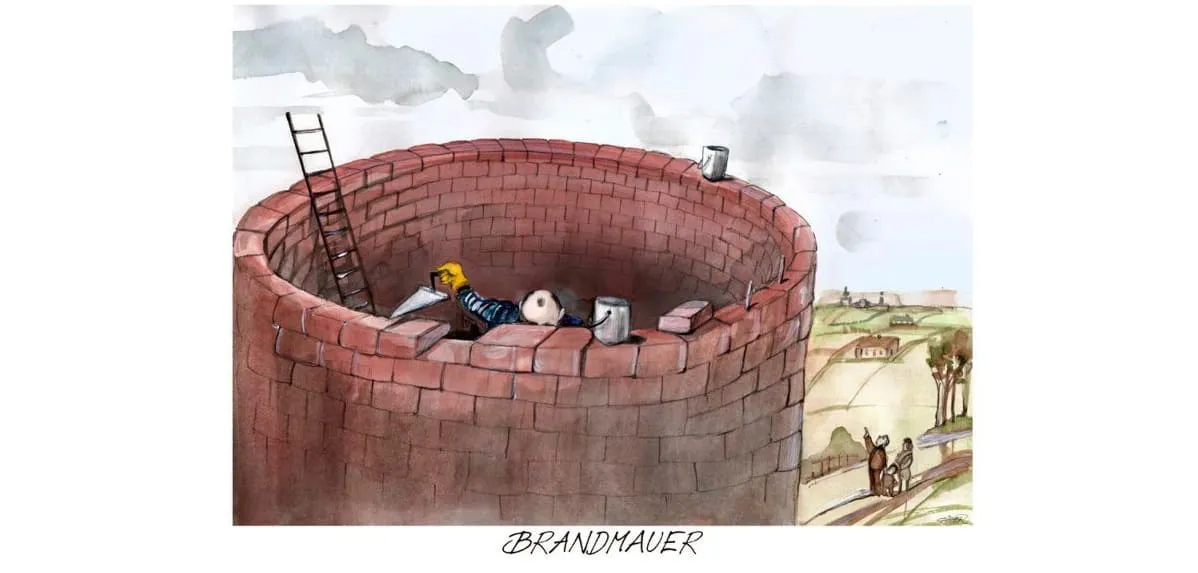
BERLIN – The German public is once again presented with a sharp reflection of its political dynamics through the satirical strokes of prominent caricaturist, Wolfgang Ammer. In the latest edition of the national newspaper WELT, Ammer wittily yet profoundly depicted the firewall strategy championed by the leader of the Christian Democratic Union (CDU) party, Friedrich Merz, in early 2026, reigniting fierce discussions about the coalition landscape and ideological boundaries in parliament.
The firewall (Brandmauer) concept introduced by Merz refers to a firm rejection of collaboration or coalition formation with extremist parties, especially the far-right Alternative for Germany (AfD). This strategy forms a central pillar in Merz's efforts to position the CDU as a stable centrist force, maintaining distance from intensifying political polarization.
However, as Ammer satirically suggests through his caricature, building such an ideological wall is not always smooth. At times, this firewall creates new dilemmas, forcing the CDU to navigate a complex political terrain, especially at the state level where cooperation with a broader political spectrum is often unavoidable.
Wolfgang Ammer, with his global reputation as a keen observer of world events, consistently succeeds in capturing the essence of an issue through provocative visual perspectives. His work in WELT this time is not merely a picture; it is a socio-political commentary that invites the audience to contemplate the effectiveness and consequences of the political strategies adopted by their leaders.
The criticism or praise Ammer delivers through his brush is not unfounded. Several political observers note that although the intention behind Merz's firewall is to protect democracy from extremism, its implementation often faces challenges. The consistently significant percentage of AfD votes in some regions indicates that a mere rejection strategy might not be enough to address the root causes of voter dissatisfaction.
The debate surrounding this firewall also takes place amid rising global tensions and complex domestic German issues, ranging from the energy crisis to integration challenges. These conditions make Merz's political narrative increasingly crucial in determining the country's direction in 2026 and beyond.
A senior German journalist, who recently voiced similar concerns, emphasized the importance of ensuring Berlin does not fall into left-wing hands or the far-right. This view reflects anxiety about political fragmentation and the importance of moderate forces in maintaining stability. German Journalists Speak Out: Berlin Must Not Fall to the Left!
The impact of Ammer's caricature will likely resonate widely, prompting the public to delve deeper into the positions of political parties ahead of upcoming elections. Whether Merz's firewall will become a solid defensive fortress or a strategic trap, only time will tell.
In the context of German political history, the idea of a red line or firewall is not new. Major parties often try to distance themselves from certain extremes to maintain legitimacy and electoral support. However, each era has its unique challenges, and 2026 is no exception.
Political sociologists argue that the effectiveness of a firewall heavily depends on the ability of moderate parties to offer concrete and convincing solutions to real societal problems. Without this, merely rejecting political opponents may not be enough to win the hearts of voters seeking change.
Wolfgang Ammer's caricature serves as a reminder that art plays a vital role in journalism. More than just entertainment, it functions as a critical mirror reflecting political reality, stimulating thought, and fostering healthy dialogue in a democratic society.
Editorial Insight: Ammer's caricature of Merz's firewall is an intriguing barometer for Germany's political climate in 2026. It highlights the inherent challenges of upholding ideological boundaries in an era of increasing polarization. Public reaction to this satirical work can provide crucial clues about the extent to which Merz's strategy is accepted or debated, as well as its potential impact on future government formations.