 Edward DP Situmorang
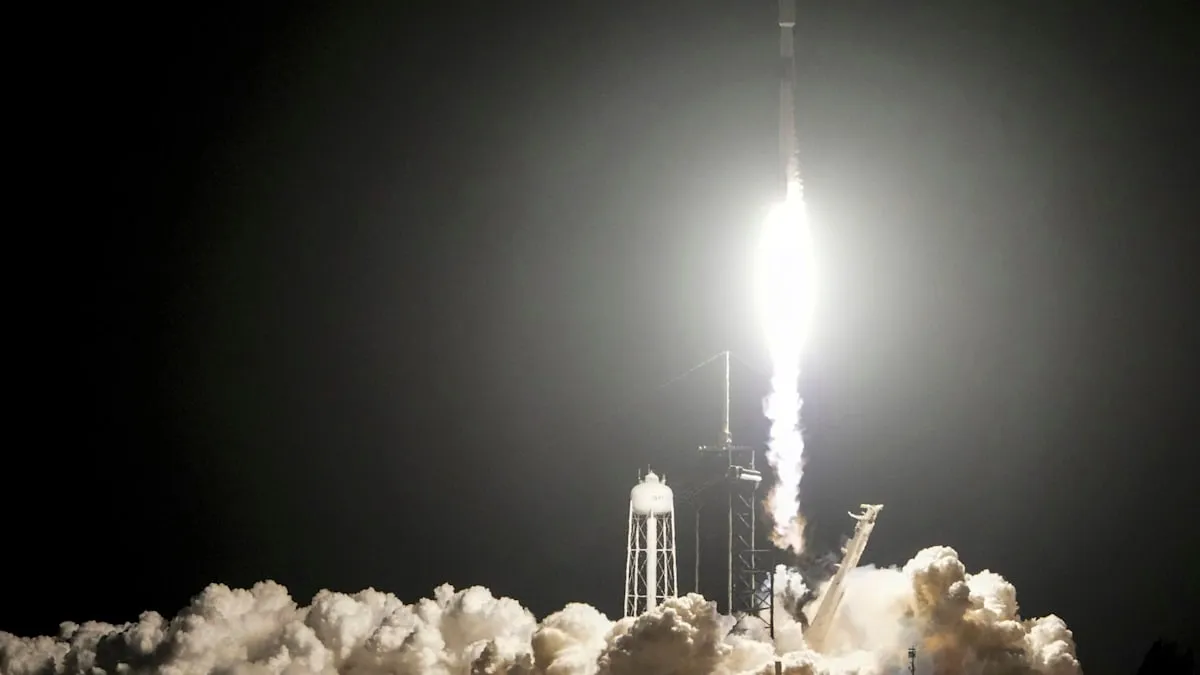
Jakarta — An unusual space incident has sparked excitement among the global scientific community. A spent rocket stage from leading space company SpaceX, owned by tech billionaire Elon Musk, has impacted the Moon's surface. This event, which actually occurred in early 2022 but has resurfaced as a topic of recent analysis by experts in 2026, is now a hot subject among astronomers, who describe it as a golden research opportunity.
Former renowned German astronaut, Ulrich Walter, explicitly stated that astronomers are "very pleased" with this event. His statement underscores the paradox where an incident typically seen as a failure or problem is instead viewed as a boon for science.
The impact is expected to have created a new crater on the far side of the Moon, which has not been mapped in detail. This is not merely a scar on Earth's natural satellite, but a rare window into the lunar subsurface layers that were previously inaccessible.
Scientists hope to analyze the material ejected by the impact. This data has the potential to provide crucial insights into the Moon's geological composition, its formation history, and its internal dynamics, which still hold many mysteries.
"Analyzing the formed crater, as well as the spectrum of ejected material, will yield valuable data," explained a senior researcher from the Southern Sky Observatory. "It's like a natural drilling operation that requires no expensive costs, carried out by an object that happened to pass by."
The rocket in question is the second stage of SpaceX's Falcon 9, launched in 2015 for the NOAA's Deep Space Climate Observatory (DSCOVR) weather satellite mission. After completing its task, the rocket stage became uncontrolled space debris, drifting in space for years before finally colliding with the Moon.
Although this collision was an unplanned event, astrophysicists view it as a large-scale passive experiment. They can study how high-velocity solid objects interact with the surface of a celestial body without a protective atmosphere.
The presence of space debris in Earth's orbit and beyond is indeed a serious concern for the scientific community. However, in this specific case, the impact occurring far from Earth opens up unique research opportunities. The Threat of Space Cowboys: Megaconstellation Satellites Trigger Global Alarm! is one of the issues often discussed regarding the increasing density of human-made objects in space.
This phenomenon also highlights the complexity of tracking objects in outer space. The rocket stage had lost control and energy, making it a passive object whose movement was influenced by Earth's and the Moon's gravity.
Research teams worldwide are now attempting to point their telescopes and observational instruments towards the impact area on the Moon. They hope to obtain high-resolution images of the new crater and collect spectroscopic data to identify exposed chemical elements.
This impact reminds us of the increasingly widespread footprint of human activity in space, even extending to the Moon. Yet, from an unexpected event, the potential for discoveries that could change our understanding of the solar system also arises.
"Every incident in space always offers lessons," Walter added in his interview. "In this case, the universe has given us an invaluable 'gift' for further research." This reaffirms the scientists' positive view of the event.
This excitement is also fueled by the fact that data from the new crater can be validated with data from previous lunar landing missions, such as Apollo and Chang'e. This allows for more comprehensive comparisons and understanding of the Moon's internal structure.
While SpaceX has not directly issued an official statement regarding this impact as a research opportunity, the unintentional contribution of their rocket has carved a new chapter in lunar research. It also demonstrates how the remnants of human exploration can unexpectedly become scientific tools.
Further research into this SpaceX rocket impact will be an integral part of global efforts to deepen our understanding of the Moon's origins and evolution. Findings from this study could influence future lunar exploration missions, including planned human landings.
From a journalistic perspective, this narrative highlights how the perception of an event can drastically shift depending on the context. What appears to be an "accident" to some, becomes a "golden opportunity" for scientists eager for knowledge.