 Dodi Irawan
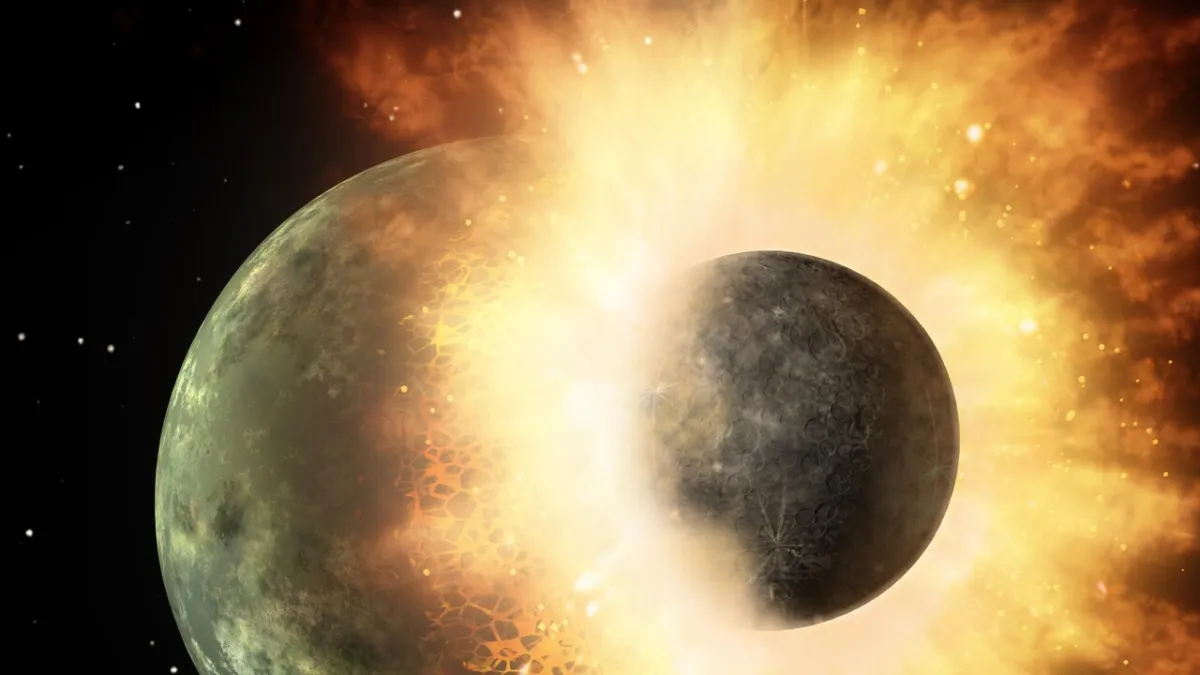
JAKARTA – Recent scientific simulations have upended conventional understanding regarding the Moon's origin, suggesting that Earth's natural satellite likely formed in a matter of hours, rather than thousands of years as previously believed. This revolutionary finding, derived from modeling the giant impact between the early Earth and the protoplanet Theia, challenges the long-dominant gradual accretion theory.
This cutting-edge research offers a new perspective on how the Moon could have formed so rapidly following a catastrophic cosmic collision. Scientists utilized supercomputers to run high-resolution simulations, replicating the extreme conditions billions of years ago when the solar system was in its early stages of formation.
Previous models generally depicted the Moon forming from debris ejected into orbit after the impact, gradually coalescing over millennia. However, this scenario often struggled to explain the isotopic compositional similarities between the Moon and Earth.
The latest simulations reveal a far more dramatic and swift scenario. Following the colossal impact with Theia, material from both celestial bodies not only dispersed but immediately formed a stable, Moon-like structure in orbit within just a few hours.
This rapid process created a hot, largely molten Moon with a composition strikingly similar to Earth's mantle. This model successfully addresses the isotopic anomalies that posed significant questions for earlier theories.
Theia, estimated to be Mars-sized, played a pivotal role in this cataclysmic event. Its collision with the proto-Earth not only reshaped Earth's surface but fundamentally determined the Moon's destiny.
This research highlights the power of modern computing in solving complex astronomical mysteries. The data generated from these simulations provides unprecedented detail about fluid and gravitational dynamics on a cosmic scale.
The implications of this discovery are vast for planetary science. If the Moon indeed formed in a matter of hours, it could change how we understand the formation of other natural satellites in the universe and the early evolution of rocky planets.
Researchers also propose that this rapid formation model might explain why the Moon has a relatively thin crust for its size. The energy released during its swift creation could have influenced the Moon's internal structure.
While these findings are highly promising, the scientific community still requires further study and observation to fully validate this new theory. Future missions to the Moon, including more in-depth analysis of rock samples, could provide crucial data.
This discovery also prompts a rethinking of astronomy textbooks. The Moon's journey, from mere hypothesis to a rich object of study, continues to present surprises.
We are on the verge of a deeper understanding of one of Earth's closest neighbors, a celestial body that has influenced tides, climate, and even life on our planet for billions of years.
Editorial Insight: This finding represents a significant leap in our understanding of the solar system. If the theory of the Moon's formation in hours proves robust, it will not only rewrite the history of our satellite but also pave the way for new investigations into the formation of planets and moons around exoplanets. It underscores the importance of continued investment in scientific research and advanced simulation technology to unlock the universe's secrets.