 Stefani Rindus
JAKARTA – A powerful geomagnetic storm that struck Earth in 2024 has triggered an extraordinary phenomenon: the formation of additional radiation belts around the planet. This significant discovery, announced by scientists in 2026, opens a new chapter in humanity's understanding of the complex interactions between the Sun and Earth, as well as its potential impacts on space technology and life.
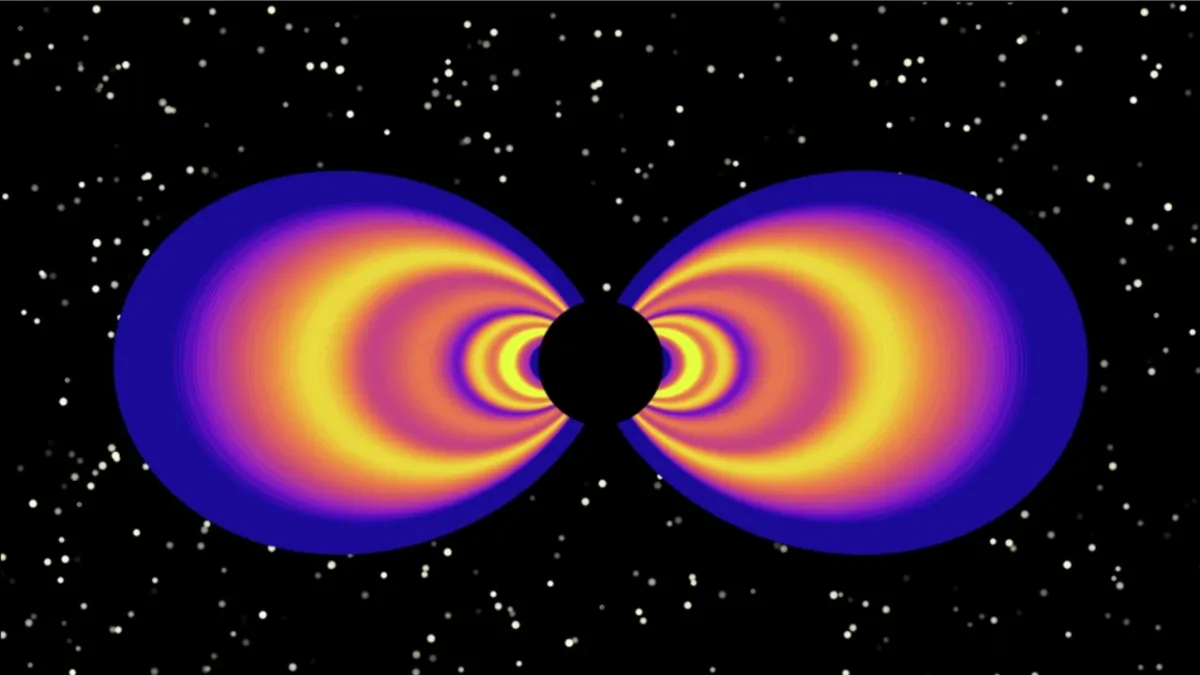
Recent observations confirm the existence of these new radiation zones within Earth's magnetosphere, the region above the atmosphere controlled by the planet's magnetic field. Researchers suspect these extra radiation belts were created by the immense energy released during the solar storm two years ago, known as one of the most intense in the past decade. The storm sent a surge of high-energy particles towards Earth, disrupting its protective magnetic field.
Professor Antonius Suryo, an astrophysicist from the National Center for Space Studies, stated that such events, though rarely observed in detail, likely occurred in the past. 'The 2024 geomagnetic storm event was indeed exceptionally intense, causing significant disturbances to Earth's magnetic field,' Professor Suryo said in an exclusive interview in Jakarta, Wednesday (May 22, 2026). 'Our initial hypothesis points to the massive energy from the storm successfully trapping and accelerating particles, thus triggering the formation of temporary or even semi-permanent radiation belts. Current observations provide far more detailed data than ever before.'
Geomagnetic storms are major disturbances to Earth's magnetosphere that occur when solar winds – streams of charged particles from the Sun – interact very strongly with Earth's magnetic field. These events can trigger spectacular auroras, but also have the potential to cause disruptions to communication systems, power grids, and satellites. The intensity of the 2024 storm was recorded as an anomaly, providing physical evidence of the phenomenal power originating from solar activity.
Earth already possesses two natural radiation belts, known as the Van Allen Belts, which consist of high-energy charged particles trapped by Earth's magnetic field. These belts extend thousands of kilometers above the planet's surface. The discovery of additional radiation belts after the 2024 storm indicates more complex and extreme dynamics in the interaction between solar activity and Earth's space environment.
The precise mechanism behind the formation of these new radiation belts remains a subject of intensive research. However, scientists speculate that shock waves from the 2024 geomagnetic storm were capable of compressing Earth's magnetic field lines, which in turn trapped more solar and cosmic particles. These particles were then accelerated to very high energies, forming dense radiation zones between or beyond the existing Van Allen Belts.
The presence of these extra radiation belts carries serious implications for space exploration and satellite operations. Satellites orbiting in these regions are at risk of electronic component damage due to high radiation exposure. Satellite operators and space agencies now face the challenge of modifying orbital paths or strengthening radiation shielding on their devices to maintain operational continuity.
Scientists are also striving to understand whether these additional radiation belts are temporary or will persist for a longer duration. Continuous monitoring of Earth's magnetosphere is crucial for predicting and mitigating future risks. Data from dedicated satellite missions, such as NASA's magnetospheric missions, will be key in unraveling the evolution of this phenomenon.
This discovery underscores the importance of global collaboration in space physics studies. Various space agencies and research institutions worldwide have increased data exchange and analysis to comprehensively understand what transpired after the 2024 geomagnetic storm. Better knowledge of these dynamics will help protect space-based infrastructure, which is increasingly vital for modern civilization.
The impact of geomagnetic storms and the formation of new radiation belts serve as a clear reminder that Earth is not an isolated entity in the universe. Solar activity has direct and significant influence on Earth's environment. A deep understanding of these phenomena will strengthen our ability to face the challenges of potentially damaging space weather in the future.
Editorial Insight: The discovery of additional radiation belts post-2024 geomagnetic storm serves as an early warning for the world. It indicates that space weather can be far more dynamic and impactful than previously anticipated. The biggest challenge now is integrating this new data into predictive space weather models and developing effective mitigation strategies. Protecting critical infrastructure in orbit and on Earth becomes a top priority, given humanity's increasing reliance on space technology.