 Edward DP Situmorang
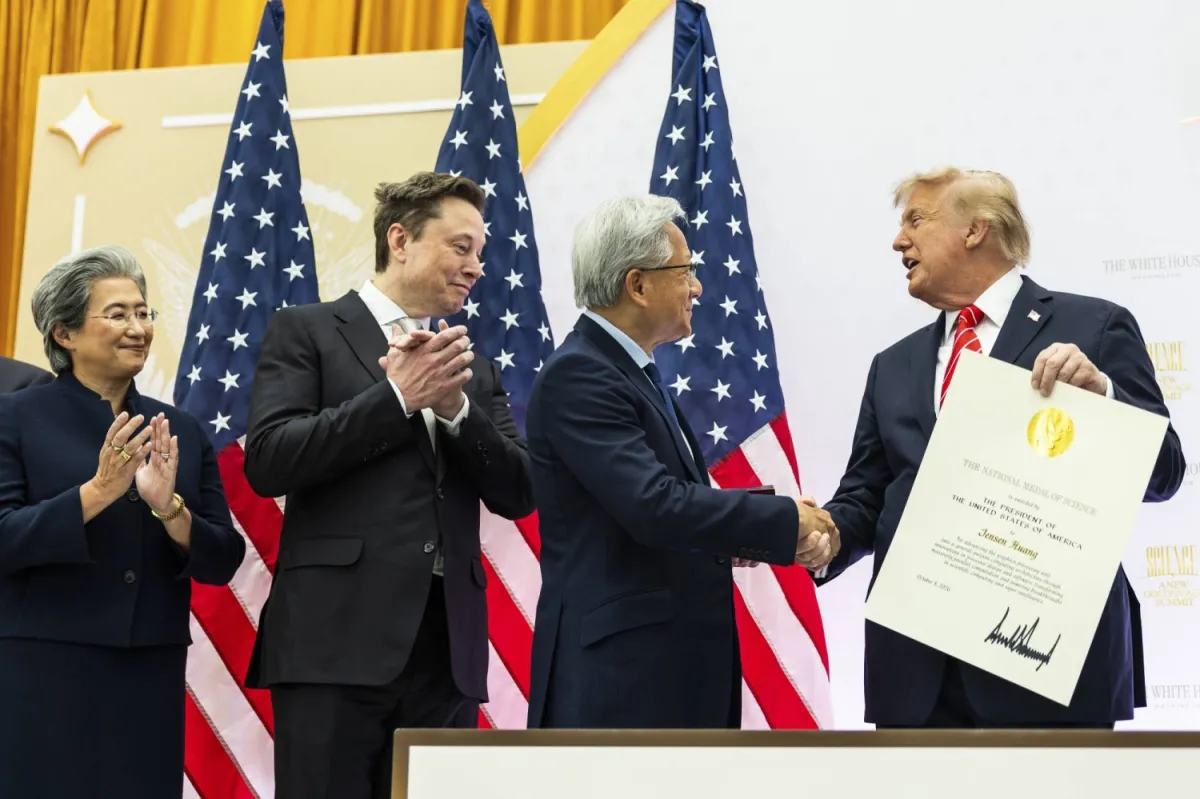
WASHINGTON – President Donald Trump has once again demonstrated his remarkable ability to wield power, even amidst significant political challenges. A recent political maneuver by him, which successfully influenced Nvidia CEO, Jensen Huang, has shaken the established lame-duck rules in Washington, United States. This development, occurring in 2026, sees the president facing a Congress controlled by the opposition party, yet he continues to project his authority beyond legislative confines.
Traditionally, the lame-duck period, or the end of a president's term after losing a legislative majority, is often perceived as a time of weakening influence. However, Donald Trump, who returned to office as President in 2026, has consistently defied such conventions. He continues to exhibit the capacity to shape policy and influence key sectors, even without full congressional backing.
Most notably is his interaction with Jensen Huang, CEO of Nvidia, the semiconductor giant now at the core of the global artificial intelligence revolution. Specific details of this influence have not been fully disclosed to the public, yet its impact is significantly felt within the corridors of power. This seems to affirm that the president's charisma and executive position remain decisive factors, far exceeding mere electoral dynamics.
This event emerges amid public scrutiny surrounding Jensen Huang's return to Nvidia, which has sparked various speculations among economic and political analysts. President Trump, known for his bold and transactional leadership style, has managed to position himself as a key player in the technology and business landscape, even when Congress is in the hands of his political adversaries.
This maneuver is more than just an isolated incident. It sends a powerful signal to the entire political and corporate elite in Washington that executive power under Donald Trump's leadership remains highly relevant. Regardless of the congressional composition, the White House continues to be a center of gravity capable of shifting policy directions and intervening in the market.
Constitutional observers are beginning to question the boundaries between the executive and legislative branches. Losing control of Congress should theoretically limit the president's scope of action. However, President Trump has instead expanded the definition of presidential power through personal diplomacy and strategic pressure on key private sector figures, as seen with the Nvidia CEO.
The motivations behind this move are diverse, ranging from efforts to secure national interests in the technology sector to simply a demonstration of political strength. With Nvidia at the forefront of AI innovation, any form of influence over the company potentially carries massive geopolitical and economic implications.
A senior political analyst from Georgetown University expressed the view that this is an important lesson on how a leader can remain powerful and influential, regardless of legislative election outcomes. He added that Trump effectively rewrote the 'lame-duck' rulebook by leveraging his personal networks and influence.
Nvidia's role as a global leader in AI chips makes it a highly strategic target. Pressure or influence from the White House can have broad economic ripples, affecting global supply chains, investments, and the future direction of technological development. This also affirms Jensen Huang's position as one of the world's most influential corporate figures.
This incident underscores an intriguing shift in the dynamics of power in the United States. The era where a congressional majority automatically implied a weakening presidency appears to be eroding, replaced by a more personal and transactional political approach. President Trump, in his own way, continues to redefine the limits of presidential power.
Editorial Insight: President Donald Trump's maneuver involving the Nvidia CEO is a clear indication that presidential influence is not always bound by legislative strength. This could set a precedent for future presidents, changing how they utilize executive power and corporate diplomacy to achieve political objectives, even in situations traditionally considered debilitating. Its impact on the balance of power in the United States will need to be carefully monitored in the coming years.