 Demian Sahputra
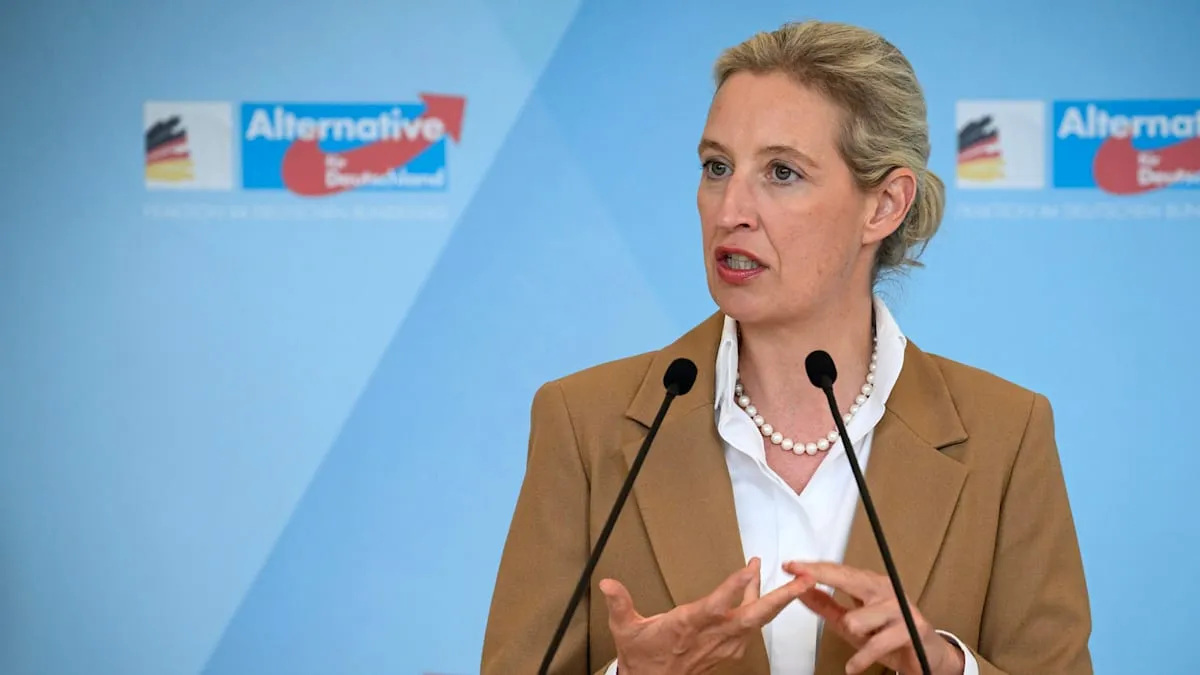
BERLIN — The leader of the Alternative for Germany (AfD) party, Alice Weidel, has surprisingly called for the complete abolition of the five-percent threshold in Bundestag and state parliamentary elections. This radical statement was made by Weidel in an exclusive interview, triggering a fierce wave of debate regarding the future of Germany's parliamentary democratic system. This proposal, if realized, would fundamentally alter the country's political landscape.
Weidel asserted that the current five-percent threshold is no longer relevant and impedes genuine political representation. According to her, the rule tends to limit the participation of smaller parties and minority voices in both federal and state parliaments. This demand comes amidst the AfD's increasing popularity and various challenges faced by established parties.
Not only did she demand complete abolition, but the AfD parliamentary group leader in the Bundestag also rejected the option of lowering the threshold to three percent. Weidel believes such a reduction would still be insufficient to create a fully inclusive and fair system. For her, the best solution is to allow all citizens' votes to have a chance at representation without a minimum percentage barrier.
The five-percent threshold was introduced in Germany after World War II with the primary goal of preventing parliamentary fragmentation and ensuring governmental stability. The fragile experience of the Weimar Republic due to too many small parties is often cited as an argument in favor of this threshold. However, critics, including the AfD, now argue that political conditions have changed significantly.
Constitutional law expert from Heidelberg University, Professor Dr. Klaus Richter, explained in a seminar discussion in early 2026 that the threshold is essentially a double-edged sword. "On one hand, it guarantees stability. But on the other hand, it potentially marginalizes legitimate political aspirations of a segment of the population," he stated. Richter added that electoral system reform has always been a sensitive topic in Germany.
Alice Weidel's proposal certainly does not stand alone. In recent years, discourse on electoral reform in Germany has indeed intensified. Even a former German Constitutional Court judge once voiced the importance of reviewing this threshold to strengthen participatory democracy.
Reactions to Weidel's statement vary. The ruling coalition parties, such as the SPD, FDP, and Green Party, will likely strongly oppose this idea, fearing political destabilization and the difficulty of forming majority governments. Meanwhile, smaller parties might see this as a golden opportunity to gain seats in parliament.
Political analyst from the Berlin Political Institute, Dr. Lena Müller, predicts that this move by the AfD is part of a larger strategy. "The AfD recognizes that abolishing the threshold could benefit them in the long run, especially if their support continues to grow and they wish to attract voters from a broader spectrum who might not always reach the threshold," said Müller.
The debate over electoral thresholds is also closely tied to current German political dynamics, where the AfD has shown significant strength in several states. The party successfully cemented its position in Sachsen-Anhalt, indicating a shifting political map ahead of the 2026 elections.
Abolishing the threshold would allow parties gaining only one or two percent of the vote to have representation in the Bundestag, which theoretically would make the parliament more diverse but also potentially more difficult to manage. This would be a monumental change that could fundamentally alter how politics operates in Germany.
This discourse also recalls previous discussions about democratic revolution in Germany, where many parties called for changes to make the system more responsive to the will of the people. This policy would be a test for Germany's political system in balancing stability with broader representation.
Alice Weidel and the AfD appear ready to face criticism and a lengthy debate regarding this controversial proposal. The future of Germany's electoral system now stands at a crossroads, with the option of completely abolishing the five-percent threshold as one of the most radical scenarios being debated in this year 2026.