 Dorry Archiles
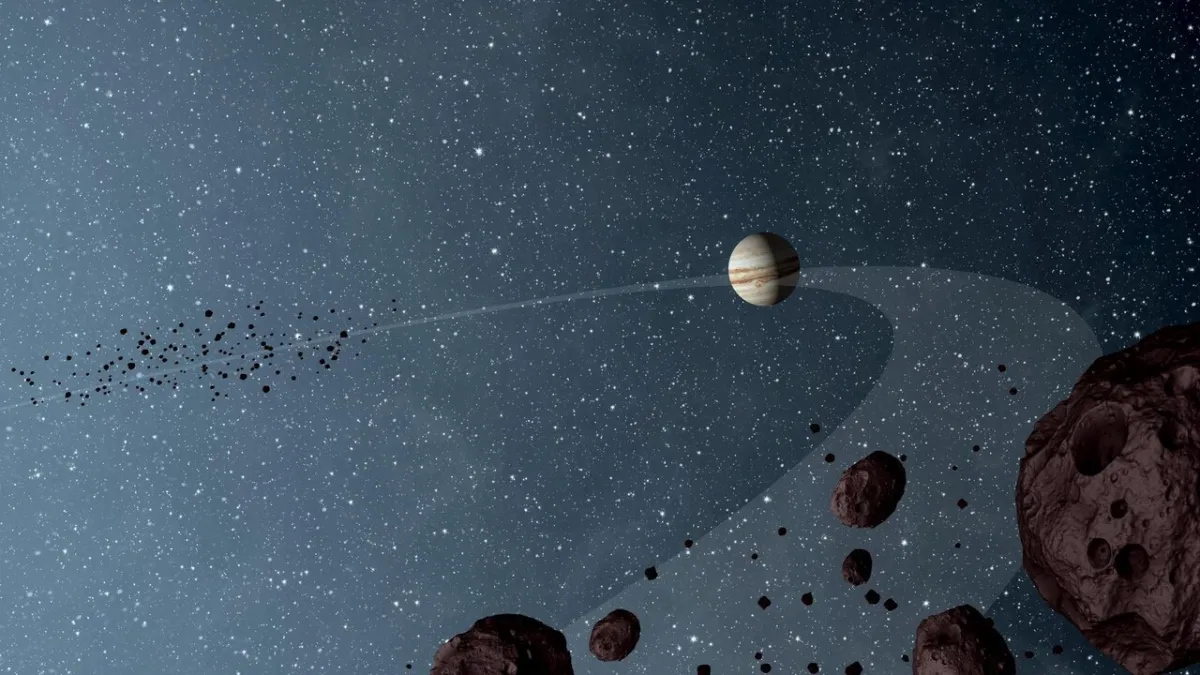
JAKARTA – After years traversing the vast expanse of space, NASA's Lucy spacecraft has finally reached the Trojan asteroid groups of Jupiter. This achievement, occurring in 2026, marks a historic milestone in cosmic exploration, allowing scientists to directly interact with what are considered 'fossils' from the dawn of our Solar System.
This exploration is not merely a routine technical maneuver, but a quantum leap in humanity's endeavor to comprehend the origins of planets and stars. The Trojan asteroids, trapped in two large clusters at Jupiter's Lagrange points, are believed to harbor primordial material that has remained virtually unchanged for billions of years, since the Solar System first began to form.
The Lucy mission was specifically designed for this inaugural journey to these never-before-visited celestial objects. The probe carries a suite of advanced scientific instruments poised to scan, analyze, and map the composition and physical characteristics of these ancient asteroids. Its goal is to open a new chapter in our cosmic history book.
Lead researchers from the mission expressed their excitement about this crucial accomplishment. 'This is a moment we have been anticipating for decades,' stated one expert, 'Every piece of data Lucy transmits will be a valuable puzzle piece to reconstruct the initial conditions of planetary formation.'
The Trojan asteroids themselves are divided into two main groups: one preceding Jupiter (dubbed the 'Greek camp') and one trailing it (the 'Trojan camp'). Lucy will visit several members of both groups, providing an unprecedented comparative analysis of the material present there.
Research on these asteroids has the potential to provide profound insights into how gas giants like Jupiter migrated in the early history of the Solar System, and how these events influenced the distribution of matter and the formation of other planets, including Earth.
In the context of space exploration, the Lucy mission reaffirms NASA's commitment to pushing the boundaries of knowledge. It complements other missions focused on near-Earth asteroids, such as the OSIRIS-REx mission to Bennu, or even impressive natural phenomena like Rare Phenomenon 2026: Halloween Asteroid Passes Earth Closer Than the Moon, but with a much more ancient target.
The data collected by Lucy is expected to reveal whether there are significant similarities or differences between the Trojans leading and trailing Jupiter. Such differences could provide vital clues about the early dynamics of the Solar System.
Furthermore, this mission also brings new hope for astrophysicists to test various theoretical models regarding planetary formation and Solar System evolution. If Lucy's findings align with predictions, it will strengthen our understanding; if not, it will pave the way for new, more accurate theories.
Lucy's success in reaching its targets in 2026 is not only a scientific triumph but also an extraordinary demonstration of advanced technology and the resilience of modern space engineering, ushering in a new era in the exploration of ancient objects in the distant asteroid belts.
Editorial Insight: The achievement of the Lucy mission is a manifestation of humanity's highest scientific ambition. By uncovering the primordial composition of the Trojan asteroids, we not only learn about the Solar System's past but also gain crucial insights into the formation processes of other planetary systems in the galaxy. This information could be key to understanding the potential for life beyond Earth, while also driving innovation in space technology that will ultimately benefit future exploration and the protection of our planet.