 Debby Wijaya
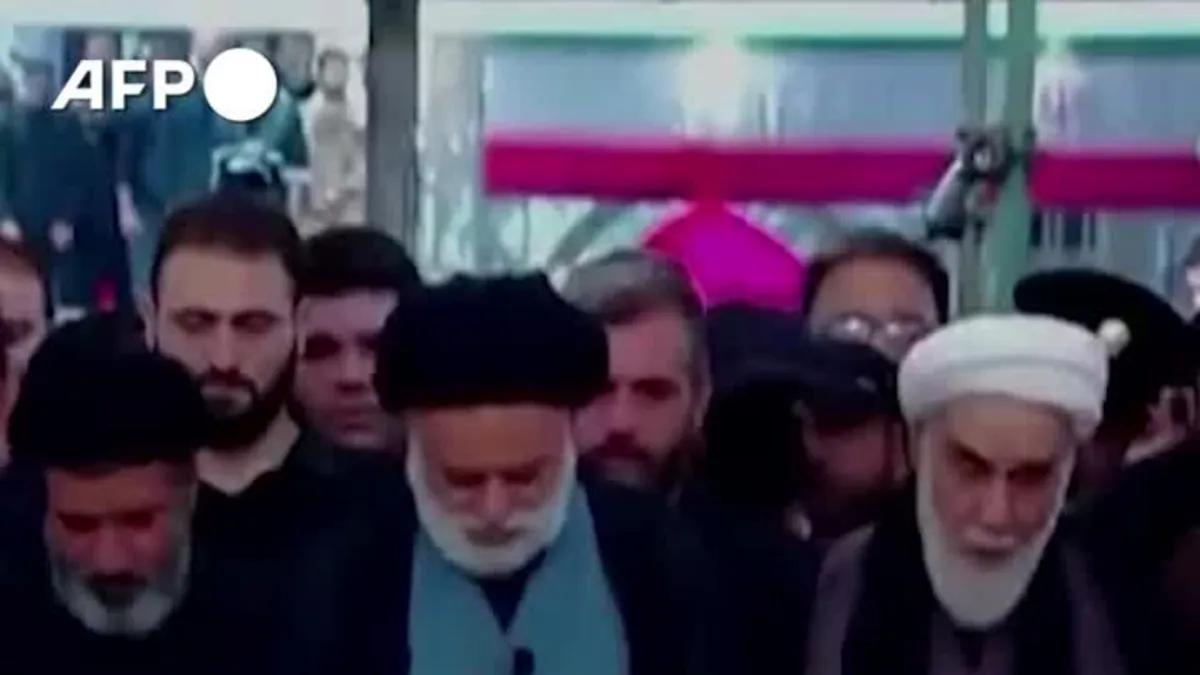
Mashhad — A figure with a closely veiled face, suspected to be Mojtaba Khamenei, the son of the late Ayatollah Ali Khamenei and a strong contender to succeed his father, was reportedly seen among a restricted group near the coffin yesterday. This appearance in the holy city of Mashhad immediately sparked widespread international speculation regarding who will assume the mantle of Iran's spiritual leadership following the Supreme Leader's death in 2026.
The presence of this mysterious figure, who appeared among the inner circle of close associates, was captured on camera and became a hot topic among Middle East political analysts. In Iranian tradition, the presence of immediate family members during crucial moments like funerals is often interpreted as a strong signal about ongoing power dynamics and succession.
Ayatollah Ali Khamenei, Iran's Supreme Leader since 1989, passed away the previous day, leaving a profound political and religious legacy. His passing opens a new chapter fraught with uncertainty for this geopolitically complex nation. The world now meticulously watches to see who will fill this leadership vacuum.
Mojtaba Khamenei, the second of eight children, is widely regarded as one of the most influential figures behind the scenes of Iranian politics. He has close ties to the Islamic Revolutionary Guard Corps (IRGC) and a network of conservative clerics, making him a formidable candidate in the race for the spiritual throne.
Speculation about Mojtaba as Khamenei's successor has circulated for years. His role in his father's office and his access to the highest echelons of power placed him in a unique position. His public appearance, even under a veil of secrecy, at an event as significant as his father's funeral, further strengthens this narrative.
The succession process for the Supreme Leader in Iran involves the Assembly of Experts, a body of senior clerics tasked with electing and overseeing the Supreme Leader. This process is usually conducted behind closed doors and is highly sensitive, making every clue or sighting crucial to observe.
International observers highlight that this succession will largely determine the direction of Iran's foreign and domestic policies. Whether Iran continues its conservative hardline stance or opens up to change will depend on who is ultimately chosen. The reputation of Iran's constitutional credibility is also at stake, as discussed in the related article Nations Promise, Citizens Await: Credibility in the Eyes of the 2026 Constitution.
Domestically, the Iranian public also feels the tension ahead of the official announcement. Various political factions—from reformists to hardliners—will undoubtedly seek to position their preferred candidates or influence the Assembly of Experts' decision for their respective interests.
Security around the funeral site in Mashhad was maximized, reflecting the high sensitivity of this power transition moment. Prominent military leaders and senior clerics were present, underscoring the seriousness and weight of the event for the future of the Islamic Republic.
If Mojtaba Khamenei were indeed to become the Supreme Leader, this would mark an unprecedented hereditary succession in Iran's modern history, given that the Supreme Leader is an elected, not inherited, position. This could trigger internal and external debates regarding the country's legitimacy and political stability.
The current situation in Iran is fraught with complex political dynamics, where every move and appearance of a figure carries deep meaning. The mystery behind the veiled face at Khamenei's funeral is just one of many puzzles that will unfold over time, shaping Iran's face in the coming years.
The international community is also closely monitoring these developments. Iran's relations with global and regional powers, especially amidst ongoing tensions, will be significantly influenced by the new leader. The world holds its breath, awaiting the resolution of this crucial transitional period. Only time will tell if the mysterious figure was indeed Mojtaba, and what implications it holds for Iran's future.