 Robert Andrison
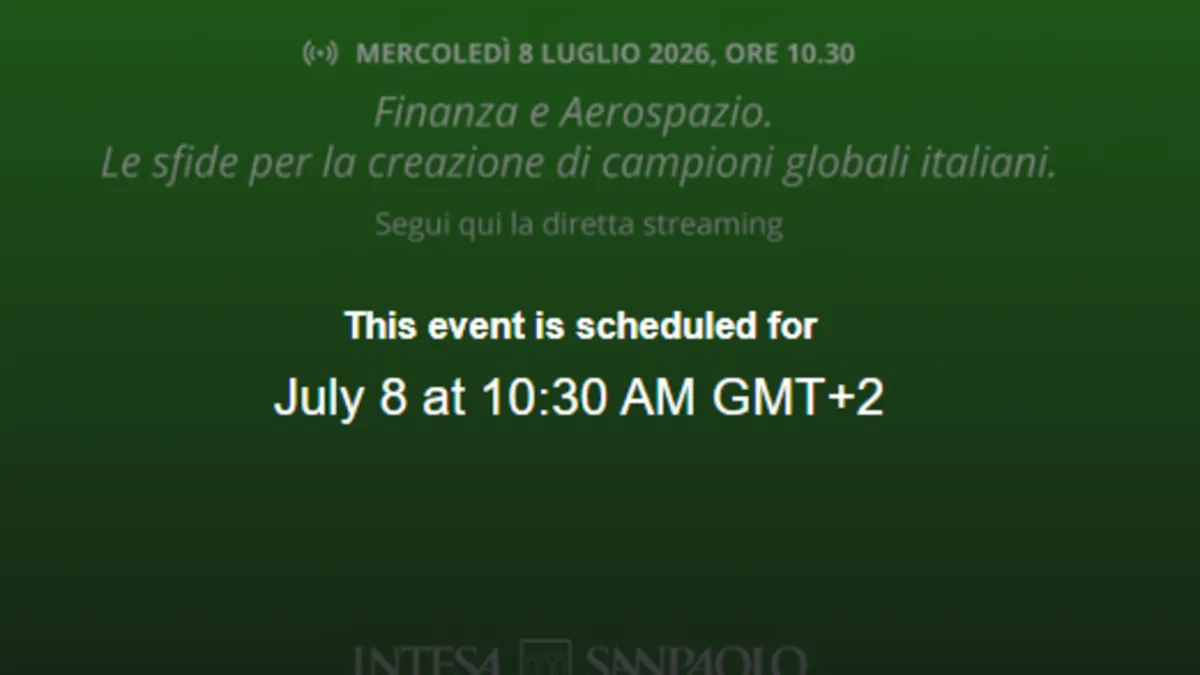
Turin — Piedmonts capital, Turin, became the epicenter of global economic and technological discourse on Wednesday, July 8, 2026, as the Intesa Sanpaolo skyscraper auditorium hosted a pivotal event on Finance and Aerospace. This strategic sector is poised to shape Italy's future, with the gathering specifically highlighting the immense challenges and potential of the space economy, a concept also known as the Space Economy, which is now a central pillar for innovation and sustainable investment.
The event, broadcast live on ANSA.it, convened key stakeholders from the financial and space industries to deliberate on how synergy between these two fields can propel national economic growth. Discussions focused on strategies to bolster Italy's global competitiveness, particularly in segments encompassing space exploration, satellite communication, and the utilization of space-derived data.
Experts underscored the imperative for increased private and public investment to fund cutting-edge research and development. The aerospace sector, historically strong in Italy, now navigates a more complex market dynamic, necessitating innovative financing models and strategic partnerships. Key challenges include access to venture capital, adaptive regulatory frameworks, and the development of a highly skilled workforce.
The choice of Turin as the venue is deeply rooted in the city's long history as a hub for industry and innovation in Italy. Intesa Sanpaolo, one of the nation's largest financial institutions, provided a crucial platform for dialogue between the financial and high-tech sectors. Their involvement underscores the banking industry's commitment to supporting the national vision of leadership in space.
The space economy, an increasingly relevant concept in 2026, transcends mere rocket launches and satellites. It encompasses the entire value chain, from component manufacturing, software development, satellite-based data service providers, to terrestrial applications such as precision navigation, climate monitoring, and high-speed internet. This sector is projected for rapid growth, promising multi-trillion-dollar business opportunities.
The Italian government has demonstrated a strong commitment to the development of the space economy, deeming it a strategic pillar for national resilience and innovation. Various policy initiatives and fund allocations have been launched to stimulate this ecosystem, fostering collaboration among universities, startups, and multinational corporations.
Given the intense global competition from nations like the United States, China, and the United Arab Emirates, Italy strives to assert its position. A focus on specific niche markets, such as high-precision earth observation or environmentally friendly propulsion technologies, is crucial for building a comparative advantage.
Technological aspects formed a central part of the discussions. Innovations in lightweight materials, artificial intelligence for space data analysis, and the development of secure quantum communication systems were hot topics. The integration of these technologies is expected to reduce operational costs and enhance the efficiency of future space missions.
Beyond economic profits, the social impact of the space economy also received attention. Satellite data is utilized for disaster mitigation, smart agriculture, and improving connectivity in remote areas. The long-term vision is to establish Italy as a sustainable space innovation hub, creating high-quality jobs and attracting global talent.
Through this forum in Turin, Italy demonstrates its earnestness in addressing the challenges of the space economy era. The synergy between finance and aerospace is expected to usher the nation into a new chapter of technological and economic prosperity on the global stage, aligning with ANSA.it's vital role as a primary digital news source.