 Dorry Archiles
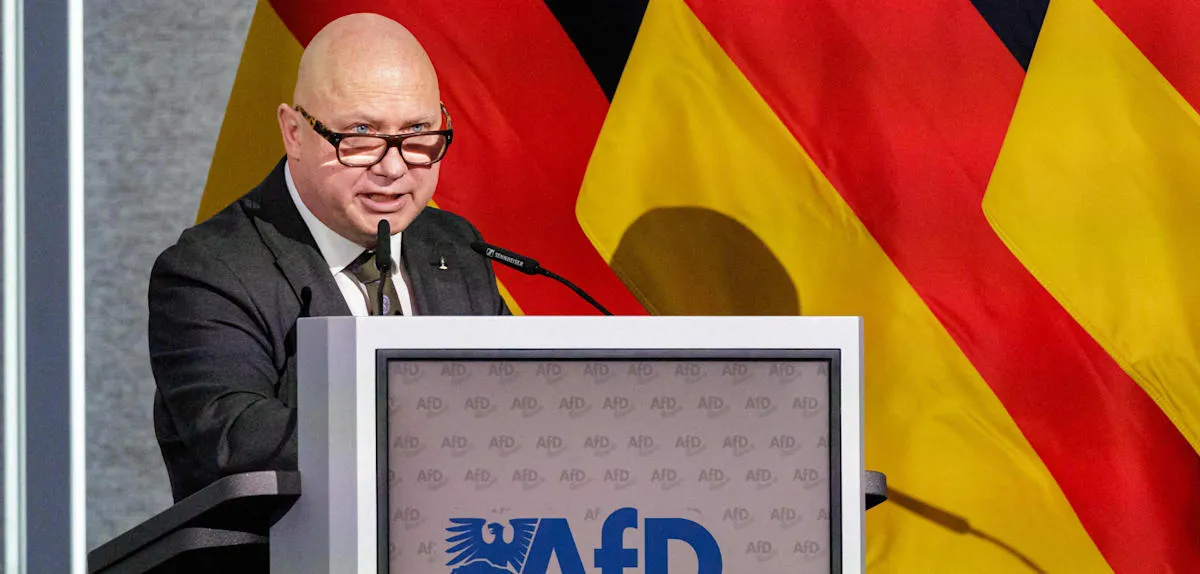
Berlin, Germany — The German political stage in 2026 is once again fraught with tension after Oliver Kirchner, a prominent politician from the Alternative for Germany (AfD) party, controversially likened CDU leader Friedrich Merz's 'firewall' policy to border security practices in East Germany under Walter Ulbricht. This scathing statement was made during a public discussion, triggering a wave of intense debate about political ethics and historical memory.
Kirchner, in his criticism, directly referred to the isolation strategy implemented by the CDU to distance itself from the AfD. He explicitly drew parallels between Merz's 'firewall', intended to prevent collaboration with the AfD, and the heavily guarded inner-German border during the German Democratic Republic (GDR) era, which is historically associated with a repressive regime.
Even more surprisingly, the AfD politician even indicated that the comparison included the 'Selbstschussanlagen' or self-firing mechanisms once installed along the GDR border. This insinuation directly implies a form of extreme or uncompromising action in the CDU's efforts to isolate the AfD from the German political landscape.
The comparison between modern party policy and symbols of repression from the East German era is highly sensitive in Germany. The period of Walter Ulbricht, leader of the Socialist Unity Party of Germany (SED) and a central figure behind the Berlin Wall, represents a dark chapter marked by severe restrictions on freedom and strict surveillance of citizens.
Friedrich Merz, as the leader of the Christian Democratic Union (CDU), has repeatedly affirmed his party's commitment to a strong 'Brandmauer' or 'firewall'. This strategy aims to prevent any form of cooperation with the AfD, which is considered by many mainstream parties to be extremist and anti-democratic.
This 'firewall' serves as a crucial pillar in the CDU's effort to maintain its identity as a moderate center-right party. They argue that there is no ideological common ground to bridge the differences between the liberal democratic values upheld by the CDU and the often divisive and democracy-questioning views of the AfD.
Kirchner's comments effectively sought to undermine this ethical commitment of the CDU, portraying it as disproportionate and historically reprehensible. This was a rhetorical attempt to attack the CDU's moral credibility in the eyes of the German public.
The political situation in Germany is indeed heating up, with the AfD continuing to show increasing popularity. This trend poses serious challenges for established parties like the CDU, which must find effective ways to respond to the AfD's rise without compromising their democratic principles. Previous reports on Germany's turbulent politics also highlighted these dynamics.
Kirchner's strong criticism will likely provoke a firm response from the CDU and politicians from across the political spectrum. They are expected to reject the comparison as an unfounded and offensive attack, especially given its invocation of the historical trauma of Germany's division.
Such debates underscore the deep polarization within contemporary German society. When sensitive historical narratives are weaponized in politics, it reflects not only inter-party tensions but also broader concerns about the direction of democracy in the country.
Political analysts predict that this incident will further exacerbate the atmosphere ahead of upcoming regional and parliamentary elections. Both the CDU and the AfD will likely use this moment to rally support from their voter bases, with increasingly sharp and provocative arguments.
Both parties now face the difficult task of navigating a turbulent political climate. For the CDU, this means reinforcing their 'firewall' with more solid arguments. For the AfD, it is an opportunity to test the boundaries of political rhetoric and attract public attention through controversy.
In a broader context, Kirchner's comparison also opens up a discussion about how collective memory and historical trauma are utilized in contemporary political discourse. This is not just a battle between two parties, but a battle of narratives that will shape how Germany views its past and constructs its future.
Credible journalism will continue to monitor these developments, ensuring the public receives accurate and balanced information, far from the distortions of excessive political rhetoric. Assessing the substance of policies, not just the sensationalism of statements, will be key to understanding Germany's political dynamics in 2026.