 Dorry Archiles
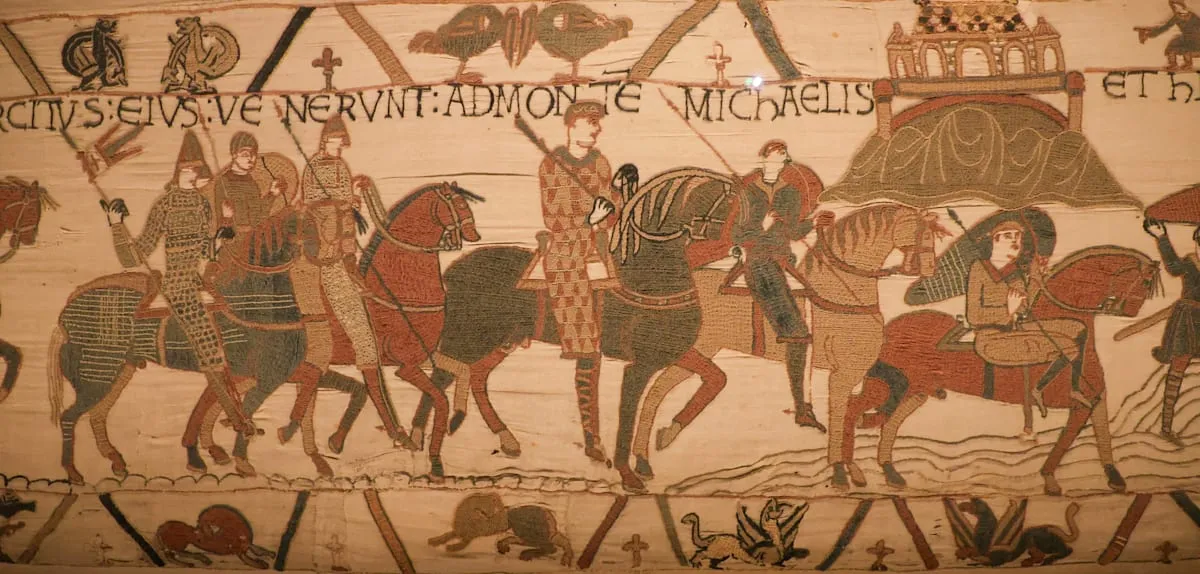
London — The year 2026 marks a crucial historical moment as the Bayeux Tapestry, a medieval artifact narrating the Norman Conquest, is exhibited for the first time on English soil. The arrival of this nearly thousand-year-old masterpiece indirectly reopens a long-standing debate about English national identity and the legacy of French dominance that shaped it. This exhibition seems to assert that the conqueror, now known as William the Conqueror, was in fact “Guillaume” of Normandy, and England was once a kind of French-speaking “colony.”
This ancient relic, stretching 70 meters, now magnificently displayed, vividly illustrates the invasion of 1066. This invasion was not merely a change of throne but a profound transformation that fundamentally altered the political, social, and linguistic landscape of Great Britain.
Historians frequently point to the Norman Conquest as the most significant turning point in English history. Before the invasion, Anglo-Saxon dominated the language. However, after the victory of “Guillaume” the Conqueror, Norman French became the language of the court, law, and administration for centuries.
This linguistic dominance created a clear social stratification, where the ruling class spoke French, while the common people maintained English. Traces of this influence are still very evident in modern English vocabulary, which is filled with thousands of words borrowed from French.
The 2026 exhibition of the Bayeux Tapestry in England presents a provocative perspective: Was England, in a period of its history, ever a “colonial” entity of France? Although the term “colony” might not be entirely appropriate for a medieval context, the idea of a nation being massively controlled and influenced by a foreign power with its own language and culture certainly carries a strong resonance.
The exhibition's curator, Dr. Eleanor Vance, explained in a recent press conference that the exhibition aims to stimulate reflection. "We want the public to see the Bayeux Tapestry not just as a work of art, but as a mirror reflecting the complex and sometimes uncomfortable history of English identity," she stated.
Another intriguing aspect is how collective memory, especially in France, tends to overlook or even forget the role of William of Normandy as a "Guillaume" who conquered England. The dominant narrative in France more often focuses on their continental power.
The debate regarding this "colonial" status is further intensified by the fact that the Bayeux Tapestry itself, though depicting events in England, was made in Normandy, France. This artifact is intrinsically linked to the conqueror's perspective.
The temporary transfer of the tapestry to England represents a significant cultural diplomatic step. It is the result of years of negotiation between the British and French governments, emphasizing the importance of cooperation in preserving and disseminating historical heritage. For more details on this transfer, readers can refer to our previous article, Permata Sejarah Abad Pertengahan: Permadani Bayeux Pindah ke London 2026.
The impact of the Norman Conquest was not limited to language but also permeated England's legal system, architecture, and feudal structure. Majestic cathedrals and castles that stand today are silent witnesses to the traces of Norman architecture and engineering.
Therefore, the presence of the Bayeux Tapestry on English soil in 2026 is not merely an exhibition of an artifact. It is a rare opportunity for the public to re-evaluate their historical roots, understand the complexities of the relationship between England and France, and confront the reality that “Guillaume” the conqueror left an indelible French mark on British identity.
The exhibition is expected to attract millions of visitors from around the world, including academics, historians, and the general public interested in medieval history. The enthusiasm is evident from the surge in ticket reservations made well in advance.
Cultural analyst, Professor Kenneth Davies from Oxford University, highlights that this exhibition also serves as a reminder of the fluidity of national identity. "Nations are not formed in isolation. English history is an interwoven tapestry of influences from various quarters, and France, in this regard, played a monumental role," he explained.
Public reaction to this "French colony" narrative varies. Some welcome it as a historical enlightenment, while others feel somewhat uneasy with the idea, which might challenge their traditional views of English pride. However, that is part of the exhibition's goal: to spark dialogue.
Ultimately, the Bayeux Tapestry is not just a historic embroidered cloth. It is a silent narrator of an era, an eternal reminder that the past, with all its ironies and complexities, continues to shape how we understand the world in 2026 and beyond.