 Edward DP Situmorang
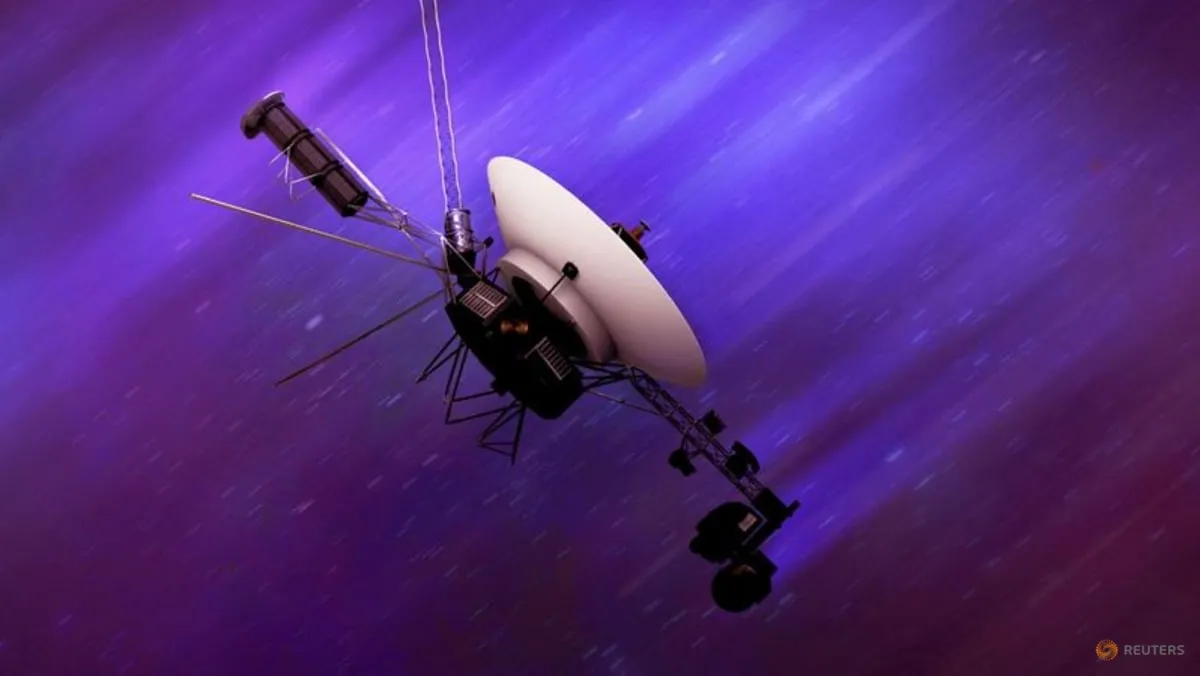
WASHINGTON – The legendary spacecraft of the National Aeronautics and Space Administration (NASA), Voyager 1, now stands on the cusp of achieving an unprecedented distance record. This unmanned probe, launched almost half a century ago, is expected to surpass a mega-distance milestone in its exploration of interstellar space, opening a new chapter in humanitys understanding of the universe.
Since its launch on September 5, 1977, Voyager 1 has served as humanitys foremost ambassador in the cosmos. Its mission was designed to explore the outer planets of the solar system, including Jupiter and Saturn, before continuing its endless journey into the vast interstellar medium. This achievement underscores the resilience and engineering prowess that allows the spacecraft to remain functional far beyond its estimated lifespan.
This distance milestone is not merely a number but a symbol of scientific perseverance and ambition. Voyager 1 has traveled over 24 billion kilometers from Earth, entering the region known as interstellar space, an area beyond the heliosphere dominated by solar wind. There, it continues to collect valuable data on magnetic fields, cosmic rays, and plasma in this alien environment.
Scientists at NASAs Jet Propulsion Laboratory (JPL) in Pasadena, California, continuously monitor every vital sign of this iconic probe. The data transmitted by Voyager 1, albeit at an extremely low speed due to the immense distance, provides direct insights into conditions beyond the Sun's dominant influence. This unique data cannot be obtained from Earth-based observations or any telescope.
In 2023, the Voyager 1 mission faced a serious challenge when one of its computer subsystems experienced a malfunction, causing the transmitted telemetry data to become unreadable. NASAs engineering team worked tirelessly for months, employing ingenuity and decades of experience to finally restore meaningful communication in April 2024, an extraordinary engineering feat that captivated the world.
That recovery proved the mission's vitality. Now, with its communication system largely restored, Voyager 1 is poised to continue its journey, carrying the Golden Record that contains sounds and images of life on Earth, intended for any alien civilization that might encounter it in the very distant future.
Voyager 1 is not alone. Its twin, Voyager 2, is also exploring interstellar space, albeit in a different direction. These two missions, together, have revolutionized our understanding of the solar system's boundaries and the nature of the environment beyond. They are silent witnesses to humanity's thirst for knowledge and exploration.
Voyager 1s relentless journey serves as a reminder that the universe is far larger and more mysterious than we can imagine. Every kilometer it travels is not just about physical distance, but also about the distance of understanding we traverse as a species. Every piece of data returned is a cosmic puzzle piece that helps us form a more complete picture.
Despite the spacecraft's advanced age, its radioisotope thermoelectric generator (RTG) power source can still supply sufficient energy for some key instruments and communication systems until approximately 2027 or even longer. This means a crucial window of time remains to gather data from its unique location.
The long-term success of the Voyager 1 mission provides inspiration for new generations of scientists and engineers. It demonstrates that with vision, dedication, and innovation, seemingly impossible boundaries can be overcome. This mission is an enduring legacy of the golden age of space exploration.
Editorial Insight:
This achievement of Voyager 1 is more than just science news; it is tangible proof of human resilience and ambition. In the context of 2026, when the world faces various global challenges such as the global chip war and European climate ambitions demanding innovative solutions, the story of Voyager 1 highlights the importance of long-term investment in fundamental research. The data collected by this spacecraft will continue to form the foundation for future space exploration missions, driving technological advancements and our understanding of our place in the universe. It is a narrative of hope amidst cosmic uncertainty.