 Debby Wijaya
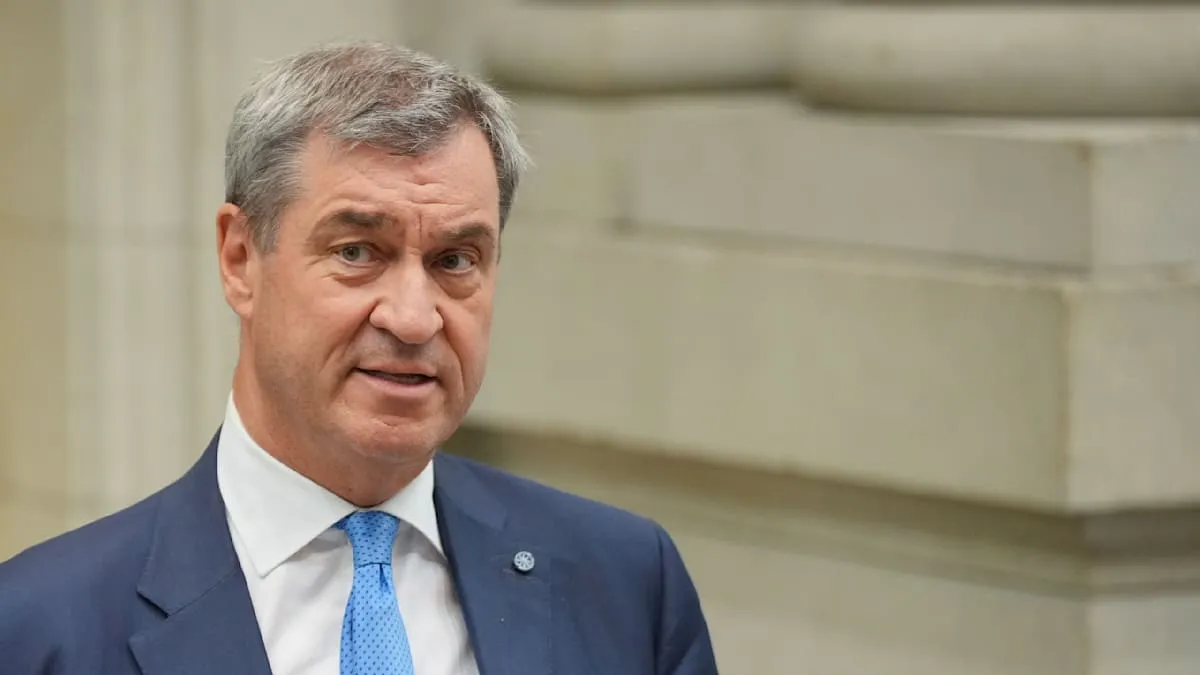
BERLIN — Germany's political landscape in 2026 is once again marked by a fierce debate concerning the handling of right-wing extremism. Discussions surrounding a potential partial ban of the Thuringian branch of the Alternative for Germany (AfD) party, initiated by some politicians from the Christian Social Union (CSU), now face strong opposition from CSU leader Markus Söder himself. Söder has openly expressed skepticism, arguing that such a ban could actually benefit the AfD.
Söder’s statement emerged as CSU politicians discussed the possibility of implementing a partial ban on the AfD in the state of Thuringia. For Söder, such a radical measure, instead of curbing the party, could provide unexpected political advantages to the party often labeled as far-right.
"I don't believe that's the right path," Söder stated, citing his concerns. "A discussion about a partial ban at the moment would rather benefit the AfD." This assertion underlines Söder's pragmatic view, which sees the potential for such drastic legal action to backfire.
The discourse surrounding a ban on AfD Thuringia is not without reason. The party’s branch, under the leadership of Björn Höcke, has long been under close surveillance by Germany's Federal Office for the Protection of the Constitution (Verfassungsschutz) due to its perceived extremist tendencies. The status of "proven right-wing extremist case" assigned by German security authorities adds weight to this debate.
However, Söder perceives a more complex dynamic. In the 2026 political context, where populist sentiments and public discontent can be easily mobilized, a ban could be interpreted as an attack on freedom of speech, even by those who do not fully agree with the AfD. This could trigger a wave of sympathy or a "victim" narrative that actually strengthens the AfD's electoral base.
The decision to ban a political party in Germany is an extraordinary and rare step, only permissible if the party aims to dismantle the fundamental democratic order. The process requires very strong evidence and approval from the Federal Constitutional Court.
Söder's argument aligns with the views of some political experts who caution democratic parties against playing with fire when dealing with extremists. Providing a large platform through prolonged legal proceedings risks unwelcome publicity and an opportunity for the AfD to position itself as a political martyr.
This debate also reflects the dilemma faced by modern democracies in confronting populist and extremist forces. It highlights the tension between upholding democratic principles of freedom of association and the duty to protect the constitutional order from internal threats.
Several other politicians across the German political spectrum have expressed diverse positions. Some advocate for a firm approach to silence extremism, while others agree with Söder that an overly harsh response could exacerbate the problem.
The AfD Thuringia case also serves as a test for the Christian Democratic Union (CDU) and CSU in defining their long-term strategy ahead of the next federal and state elections. The crucial challenge lies in how mainstream parties can regain public trust without being drawn into narratives crafted by extremists.
Previously, similar discussions regarding the handling of AfD Thuringia have sparked sharp differing views, as mentioned in the article CSU Considers Partial Ban of AfD Thuringia, Firm Stance Against Extremism. That article shows that considering a partial ban is not new, but has received varied responses from policymakers.
Now, with Söder's open rejection, pressure mounts on the CSU to formulate a more coherent and effective approach. The question of how to confront extremism without inadvertently strengthening it will continue to be at the heart of German political debate in 2026 and beyond.