 Angel Doris
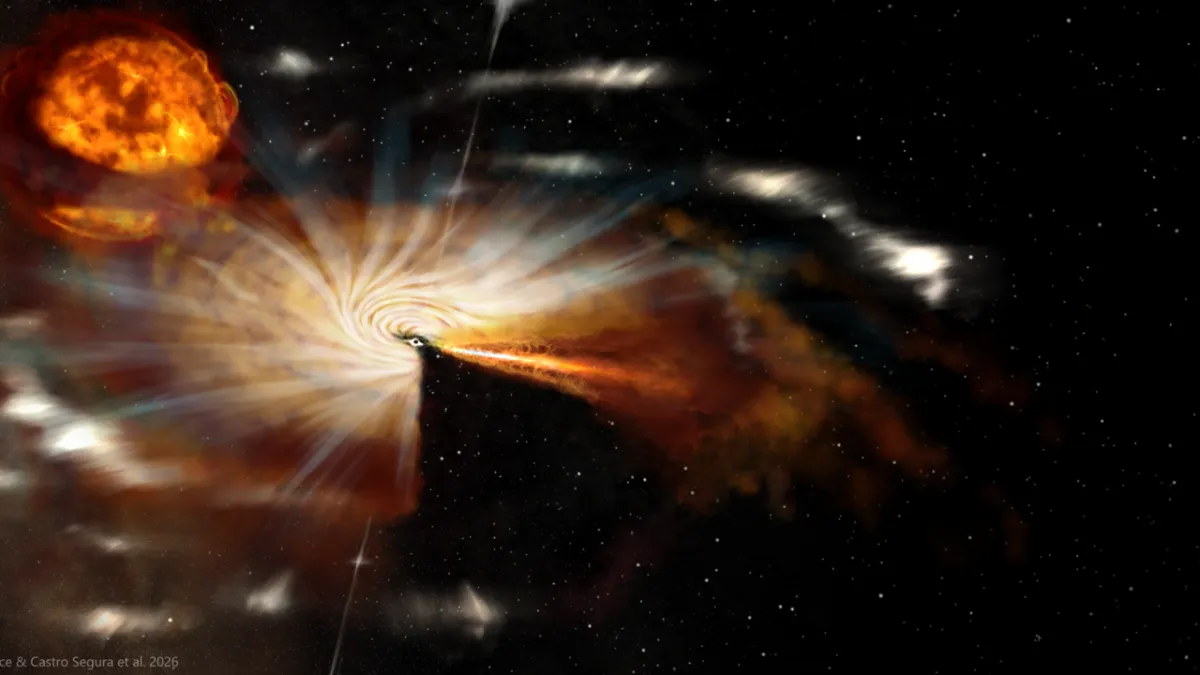
JAKARTA – A revolutionary study recently published by an international team of astronomers has shaken conventional understanding of black holes, the cosmos most enigmatic objects. Researchers successfully observed what they term cosmic indigestion, a phenomenon where black holes do not merely swallow matter indefinitely but also eject a significant portion of it in powerful energy jets. This discovery fundamentally alters the view of black holes as bottomless pits, opening a new chapter in astrophysical research.
This cosmic indigestion phenomenon was identified through observations of intense X-ray and radio wave emissions originating from near the event horizons of supermassive black holes in distant galaxies. The International Space Observatory, leveraging the capabilities of next-generation telescopes, recorded data indicating a complex feedback mechanism. When a black hole accretes excessive gas and dust, pressure and friction around the event horizon trigger colossal energy releases.
For decades, theoretical physics models assumed black holes were entities that only absorbed everything nearby, without significant expulsion mechanisms. However, the latest empirical data suggests that the process of matter accretion actually triggers relativistic jets and galactic winds capable of expelling matter from galaxy cores, even suppressing the formation of new stars.
The implications of this finding are vast. Professor Elena Petrova, a leading astrophysicist from Cambridge University, stated, This is concrete evidence that black holes are active players in galactic evolution, not merely passive entities. They moderate the growth of their host galaxies through a cycle of eating and ejecting matter.
The research was published in this month's edition of the Astrophysical Review journal. The team utilized combined data from the Chandra X-ray Observatory and the Atacama Large Millimeter/submillimeter Array (ALMA) radio observatory to confirm previously undetected emission patterns.
Dr. Kenji Tanaka, project leader from the Tokyo Astrophysics Research Center, explained that These extremely powerful energy jets can escape the black hole's gravitational pull, carrying away gas and dust that would otherwise fuel star formation. This explains why some giant galaxies have relatively few new stars, despite possessing abundant gas reserves.
The concept of active feedback from black holes, now empirically validated, provides crucial clues about how galaxies evolve and form the structures we observe in the universe. It also potentially offers new insights into dark matter and dark energy, two of modern cosmology's greatest mysteries.
Previous studies often struggled to explain the relationship between the growth of supermassive black holes and the rate of star formation in their host galaxies. With this evidence of cosmic indigestion, scientists now have a more comprehensive framework to reconcile these two phenomena.
Further in-depth observations will focus on the frequency and intensity of these indigestion events across various types of black holes, from stellar-mass to supermassive ones. Hopefully, this will help astrophysicists map the lifecycle of galaxies with greater accuracy.
The collected data will also serve as a basis for developing more accurate cosmological simulation models, enabling scientists to predict the universe's evolution with better precision. These findings reaffirm that the universe is far more dynamic and complex than previously imagined.
This is not merely an academic discovery; it is a paradigmatic leap that will influence the direction of global astrophysical research for decades to come. Ultimately, black holes are not static entities that only pull in, but dynamic entities that also expel, shaping the cosmic landscape around them.
Editorial Insight: This finding indicates that our understanding of the universe is still in its nascent stages. The concept of cosmic indigestion opens up unexpected possibilities regarding the interaction between massive objects and their surrounding environments. It's not just about black holes, but also about how energy and matter are redistributed, influencing galactic evolution as a whole. Governments and global research institutions need to increase investment in advanced observatories to continue uncovering fundamental mysteries like these, ultimately enriching our knowledge of the cosmos' origins and future.