 Stefani Rindus
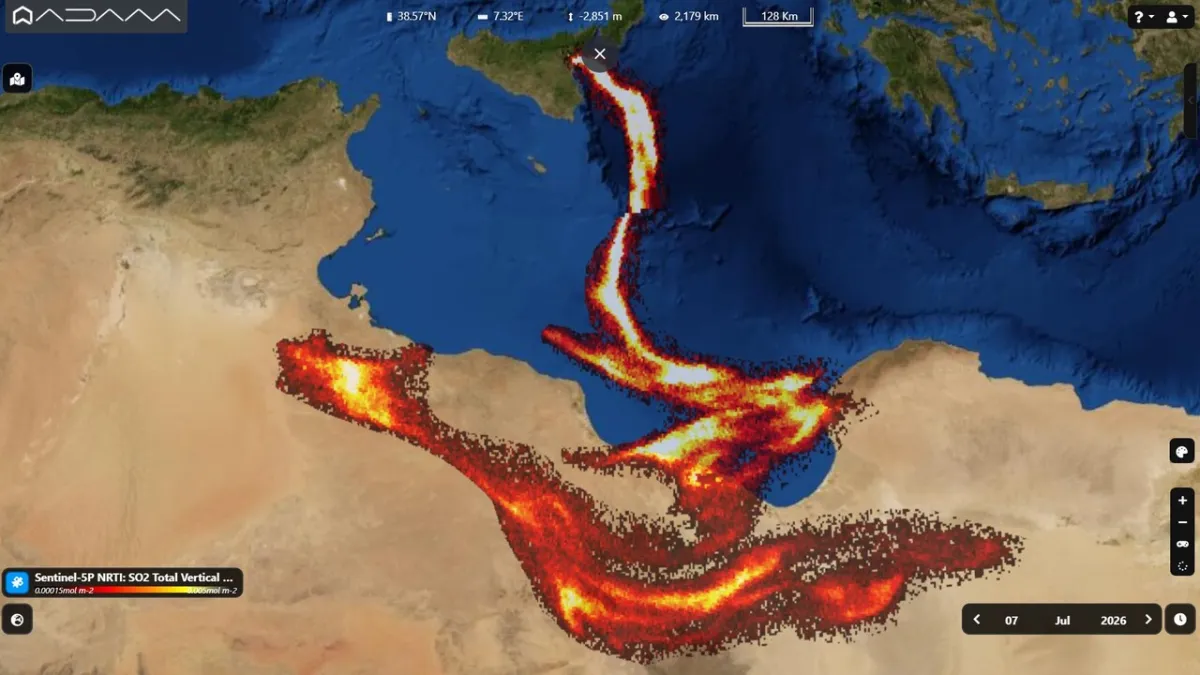
ROME – Mount Etna, one of the world's most active volcanoes, once again showcased its formidable power in early 2026. A massive plume of sulphur dioxide from its summit was observed by the European satellite Sentinel 5P, traversing the Mediterranean Sea and enveloping parts of North Africa, drawing global attention to Europe's geological dynamics.
This event marks a significant escalation in volcanic activity with broad environmental and atmospheric implications. Volcanologists and atmospheric scientists are now closely monitoring the movement of the gas cloud and its potential impacts.
Images captured by Sentinel 5P clearly show the remarkable spread of sulphur dioxide (SO2) concentration. The gas was detected stretching hundreds of kilometers from Sicily, Italy, reaching as far as Morocco, Tunisia, and Algeria.
Sulphur dioxide is a major volcanic gas that can cause acid rain and negatively impact air quality. Although its concentration may have been diluted far from its source, its presence in large volumes in the atmosphere remains a subject of serious observation.
The Sentinel 5P satellite, part of the European Union's Copernicus program, is specifically designed to monitor global atmospheric composition. Its ability to detect gases like SO2 with high resolution makes it a crucial instrument in understanding events such as Etna's eruptions.
Researchers from Italy's National Institute of Geophysics and Volcanology (INGV) explained that Etna is indeed a highly active volcano. However, the dispersal of volcanic gases this far into North Africa is a phenomenon that requires further analysis of regional wind patterns and eruption strength.
\"This is a clear example of how geological activity at one point on Earth can have a very wide range of impacts,\" said a climate expert from the University of Catania, remaining unnamed for anonymity in this news report. \"Sentinel 5P provides invaluable data for predictive and mitigation models.\"
Although there have been no direct reports of serious health impacts on the population in North Africa so far, authorities in those countries have been advised to monitor local air quality, especially for those with sensitive respiratory conditions.
Such phenomena also provide critical data for climate scientists. Volcanic gases and particles can affect Earth's radiation balance and weather patterns in the short term, although their impacts are usually local or regional and temporary.
The Italian government and the European Union continue to invest in advanced monitoring technologies to mitigate risks from natural disasters. The data from Etna this time will enrich the global database on volcanic behavior and its interaction with the atmosphere.
This event also underscores the importance of international scientific collaboration. Data collected by the European Sentinel 5P satellite is widely shared with the global scientific community, enabling a more comprehensive understanding of Earth's systems.
With Etna's activity ongoing, constant monitoring by satellites and ground stations becomes increasingly vital. This ensures that any significant changes can be detected early, allowing for rapid responses to protect communities and the environment.
The public around Etna is accustomed to frequent small to moderate eruptions. However, the detected reach of the sulphur plume to another continent serves as a potent reminder of nature's unpredictable and immense power.